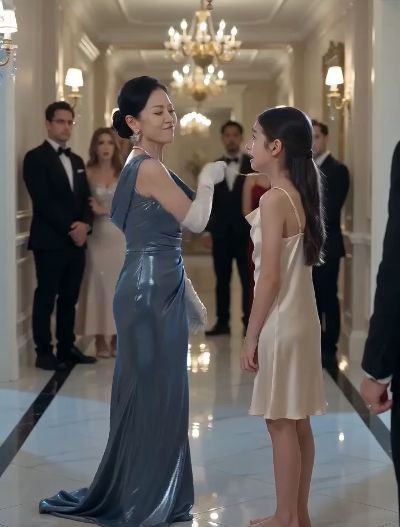
THE WOMAN TORE OFF LUCIA’S “CHEAP” NECKLACE—THEN A FALLEN FAMILY CREST EXPOSED THE CHILD SHE HAD STOLEN
The first pearl struck the marble floor like a tiny gunshot.
Conversation died beneath the golden chandeliers of the De la Vega mansion as Valeria Montoro pulled the old necklace from Lucia’s throat. The thread snapped between her gloved fingers, sending yellowed pearls scattering through the crowded hallway.
Lucia gasped and pressed one hand to the red mark around her neck.
“Don’t bring rubbish like that in front of me,” Valeria said loudly enough for every guest to hear. Her metallic blue gown glittered as she looked Lucia up and down. “Only real jewellery belongs in this house—not cheap market goods.”
A few guests laughed nervously. Others lowered their eyes.
Lucia had been hired to assist the caterers during the De la Vega Foundation’s annual gala. She wore a borrowed champagne-coloured dress and the only valuable object she had ever owned: the pearl necklace left by the woman she had always believed was her mother.
“I’m sorry,” Lucia whispered, dropping to her knees to gather the pearls. “Please give it back.”
Valeria lifted her chin. “Perhaps this will teach you not to pretend you belong among people above your station.”
Then a small silver brooch rolled from the broken necklace.
It was shaped like a seashell, its surface engraved with a crowned wave and three stars.
A pair of polished black shoes stopped beside it.
Alejandro De la Vega bent down and picked it up.
The colour drained from his face.
“This is my family crest.”
The laughter vanished.
Alejandro turned the brooch over. On the back was a line engraved by hand:
For my little Marisol, so the sea will always guide you home.
His fingers began to tremble.
That inscription had been written by his mother twenty-two years earlier, on the day his baby sister was born.
Marisol De la Vega disappeared six months later.
“Where did you get this?” Alejandro asked Lucia.
Lucia clutched several broken pearls in her palm. “It’s the only thing my mother left me.”
“What was her name?”
“Rosa.”
Valeria’s champagne glass slipped slightly in her hand.
Alejandro noticed.
He stepped between Lucia and Valeria. “She is my long-lost sister.”
Valeria forced a laugh. “That is absurd. Anyone can copy a crest.”
Alejandro looked at her with a coldness that silenced the entire hall.
“And you,” he said, “are going to explain why you recognised it before I did.”
Valeria’s face tightened.
She turned to leave, but the mansion doors closed. Alejandro’s security chief had already heard enough to understand that no guest should be permitted to depart.
Lucia stood frozen as whispers swept through the hallway. She had expected humiliation that night, perhaps dismissal. She had not expected a stranger to call her his sister.
Alejandro led her into the library, where portraits of generations of De la Vegas watched from the walls. One painting showed a woman with dark eyes holding a baby wrapped in cream lace.
Lucia stopped breathing.
The woman looked exactly like her.
“That was our mother, Isabella,” Alejandro said. “She died believing Marisol had been taken by kidnappers.”
Lucia touched the portrait’s frame. “My mother Rosa had this woman’s photograph hidden inside her Bible.”
Alejandro asked her to tell him everything.
Rosa had raised Lucia in a coastal town nearly three hundred miles away. They lived above a small laundry and survived on whatever work Rosa could find. She had been protective to the point of fear, locking doors before sunset and panicking whenever unfamiliar cars stopped outside.
She never allowed Lucia to have her photograph taken.
When Lucia asked about her father, Rosa always replied, “Some families search for children because they love them. Others search because children remember too much.”
Three months earlier, Rosa died after a long illness. Before her final breath, she gave Lucia the pearl necklace and told her to find the De la Vega mansion.
“Your name was not always Lucia,” Rosa said. “And I was not the woman who gave birth to you.”
But before she could reveal more, she lost consciousness.
Lucia came to the city with almost no money. The gala job was the closest she had managed to get to the family.
Alejandro called the police and arranged an immediate DNA test.
The result arrived the following morning.
There was a 99.98 per cent probability that Lucia was Alejandro’s biological sister.
Lucia was Marisol De la Vega.
The revelation reopened one of the country’s most infamous unsolved kidnappings.
Twenty-two years earlier, the De la Vega family controlled a shipping empire worth billions. Isabella’s husband, Arturo, had recently amended his will. If anything happened to him, his wealth would be divided equally between Alejandro and the infant Marisol.
Valeria was Arturo’s younger half-sister.
Before Marisol’s birth, Valeria expected to inherit a large portion of the company. The new will removed her almost entirely.
Six months later, Marisol disappeared from the mansion nursery.
A maid named Rosa Alvarez vanished the same night. Police concluded that Rosa had kidnapped the child for ransom. A bloodstained coat was found near the harbour, and both were presumed dead after a boat was discovered drifting offshore.
Valeria had comforted Isabella through the tragedy.
She had stood beside the grieving mother at press conferences, financed searches and publicly promised never to stop looking for her niece.
In private, she had orchestrated the entire crime.
Rosa had not kidnapped Marisol. She had rescued her.
On the night of the disappearance, Rosa entered the nursery and found Valeria holding a pillow over the baby’s face. Valeria planned to kill Marisol and stage the scene as a kidnapping. When Rosa intervened, Valeria’s driver attacked her.
Rosa escaped through a service passage with the infant.
She tried to contact Arturo, but Valeria controlled the household telephone system and had bribed the family’s security director, Hector Salas. Hector intercepted Rosa’s calls and threatened to kill the child if she returned.
Rosa fled, changed the baby’s name and raised her in hiding.
The pearl necklace and seashell brooch had been fastened around Marisol’s neck before the escape.
The investigation found the proof inside Rosa’s old laundry.
Hidden beneath a floorboard was a metal box containing letters, photographs, a bloodstained nursery uniform and a cassette recording made by Hector Salas.
Rosa had secretly met Hector twelve years after the kidnapping. By then, he was dying of cancer and consumed by guilt.
On the recording, he confessed that Valeria had ordered Marisol’s murder. He admitted altering the security footage, planting Rosa’s coat at the harbour and paying two fishermen to abandon the boat.
He also revealed something worse.
Arturo had discovered the truth seven years after the kidnapping.
Before he could confront Valeria, his car went over a cliff.
The crash had been ruled an accident.
It was not.
Valeria paid a mechanic to damage the steering system. She killed Arturo to prevent him from restoring Marisol’s inheritance and exposing her.
Isabella became ill soon after her husband’s death. Valeria gradually isolated her, controlling her medication and visitors. Isabella died believing both her daughter and husband had been stolen by fate.
They had been stolen by Valeria.
When detectives searched Valeria’s estate, they found payments to Hector, the mechanic and the fishermen. They also discovered forged company records showing that Valeria had diverted millions from trusts belonging to Alejandro and Marisol.
Valeria attempted to flee aboard a private jet.
She was arrested before take-off.
At trial, she showed no remorse.
“That child would have inherited everything,” she said. “I spent my life building that family’s power while Isabella merely produced heirs.”
Lucia sat beside Alejandro as the courtroom heard the confession.
For most of her life, she had believed poverty meant she was invisible. Now she understood that a wealthy woman had tried to erase her precisely because her existence mattered.
Valeria was convicted of attempted murder, kidnapping conspiracy, fraud and Arturo’s murder. She received life imprisonment without parole. The former mechanic and surviving fishermen were also prosecuted.
Rosa’s name was officially cleared.
Alejandro arranged for her grave to be moved from an unmarked section of the coastal cemetery to a place beside the sea. Her new headstone read:
Rosa Alvarez — She chose courage when silence was safer, and saved a child who was not born to her but became her own.
Lucia did not immediately begin using the name Marisol.
“Lucia is the name Rosa gave me,” she told Alejandro. “It carried me home.”
He understood.
She also refused to move into the mansion at first. The chandeliers, servants and silent corridors made her feel like an intruder in someone else’s life. Alejandro rented a modest apartment nearby and visited without guards or formal clothes.
They learned one another slowly.
He told her how their mother used to sing beside the nursery window. Lucia showed him how Rosa had sewn coins into coat hems so they would always have emergency money. Alejandro taught her the family history. Lucia taught him that family history meant little if it ignored the people who had cleaned its rooms and protected its children.
A year after the gala, they returned to the mansion hallway where Valeria had broken the necklace.
The scattered pearls had been restrung, but Lucia asked the jeweller to preserve the original thread inside a glass case. The seashell brooch rested at the centre.
Guests gathered again, though this time the event honoured domestic workers who had exposed abuse and corruption.
Lucia stood beneath the chandeliers wearing the same restored necklace.
Alejandro introduced her not as an heiress, nor as the missing Marisol.
“This is my sister Lucia,” he said. “She survived because a brave woman valued her life more than wealth, reputation or fear.”
Lucia looked at Rosa’s photograph displayed beside Isabella’s portrait.
Two women had been her mothers.
One gave her life.
The other saved it.
Valeria had torn the necklace away because she believed poverty made Lucia powerless. Instead, the broken pearls released the evidence that destroyed her.
The brooch did more than prove Lucia’s bloodline.
It revealed that the true inheritance of the De la Vega family was not its mansion, shipping empire or jewels.
It was the courage of the woman everyone had once accused—and the daughter who finally returned to clear her name.
