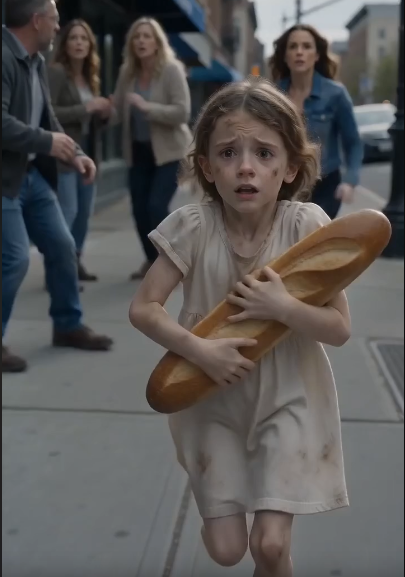
THE BAKERY OWNER CALLED HER A THIEF—THEN THE LITTLE GIRL REVEALED WHAT HE HAD REALLY TAKEN
Emma Carter was running as though the entire city had turned against her.
Bare feet struck the cold pavement. Her torn white dress snapped around her thin legs while she clutched a baguette tightly against her chest. Pedestrians stepped aside, some startled, others annoyed, but nobody stopped the frightened child racing away from the small bakery on the corner.
Detective Olivia Reed did.
She had been watching the shop from an unmarked car for three days.
When Emma stumbled near a traffic light, Olivia rushed forward and caught her before she fell into the road. The child twisted desperately in her arms.
“Let me go! Please!”
“Easy,” Olivia said. “I’m not going to hurt you.”
The bakery door slammed open.
Frank Miller charged onto the sidewalk wearing a flour-covered shirt and brown leather apron. In his hand was a heavy wooden rolling pin.
“Thief!” he shouted. “That little rat stole from me!”
Emma went rigid.
Olivia felt the child’s fear before she understood it. This was not the fear of being punished for taking bread. It was the terror of someone who believed being caught meant disappearing.
Olivia moved Emma behind her.
“I’ll pay for it.”
Frank continued advancing.
“Her debt is worth far more than a loaf of bread.”
Olivia seized his collar and stopped him in the middle of the sidewalk. Then she pulled her badge from her jacket.
“Touch her again,” she said, “and you’ll regret it.”
The anger vanished from Frank’s face.
Emma peered around Olivia’s side. Tears streaked the dirt on her cheeks.
“He took my sister,” she whispered.
The street seemed to fall silent.
Olivia lowered herself until she was level with the child.
“What is your sister’s name?”
“Sophie. She’s thirteen.”
“Where did he take her?”
Emma looked towards the bakery windows.
“Downstairs.”
Frank suddenly tried to pull away.
“She’s lying. The kid is homeless. She says anything for food.”
Olivia tightened her grip.
“Then you won’t mind us checking.”
Frank’s eyes flickered towards the bakery door.
That tiny movement told Olivia everything.
For six weeks, she had been investigating reports of children disappearing near the city’s eastern shelters. All the missing girls had passed through the same emergency placement programme. The programme’s meal vouchers were accepted at only four neighbourhood businesses, including Miller’s Bakery.
No witness had connected Frank directly to the disappearances.
Until Emma.
Olivia called for backup and led the child away from the crowd. Emma shook violently as she ate pieces of the bread she had stolen. She had not eaten properly for two days.
Between small bites, she explained what had happened.
After their mother died, Emma and Sophie had been moved between temporary homes. Three months earlier, a social worker named Diane Mercer placed them in a room above Frank’s bakery. She told the sisters that Frank would give them food and simple chores until a permanent family was found.
At first, he appeared kind.
He gave them warm rolls and allowed Sophie to help decorate cakes. But within days, he began charging them for everything: meals, blankets, soap and even the locked room where they slept.
“You owe me now,” he told them.
Sophie was forced to work through the night mixing dough, cleaning ovens and packaging bread for delivery. Emma was sent into crowded streets to collect cash donations while pretending to sell flowers.
When Sophie threatened to tell the police, Frank locked her beneath the bakery.
Emma had not seen her in four days.
That morning, Frank told her Sophie had been “sent away.” Emma heard crying through a floor vent and realised her sister was still inside. She stole the baguette because Sophie had not been given food.
Olivia’s backup arrived within minutes.
Frank insisted there was no basement.
The building plans said otherwise.
Officers entered the bakery while customers gathered outside. The front room appeared ordinary: warm bread, glass display cases and the comforting smell of sugar and cinnamon. Behind the ovens, however, Olivia noticed a metal shelf bolted into the floor.
Fresh scrape marks surrounded its base.
When officers moved it aside, they found a narrow door.
It was locked from below.
“Sophie!” Emma screamed.
A faint knock answered.
Frank ran.
He knocked over a tray, pushed past an officer and fled through the rear alley. Olivia chased him through delivery yards and between parked cars. Frank reached a van behind an abandoned warehouse, but before he could start the engine, Olivia pulled the door open and dragged him out.
Inside the vehicle were children’s clothes, forged identification cards and boxes of medication.
Frank was no longer merely a violent bakery owner.
He was part of a system.
Back at the shop, firefighters cut through the basement door. They found Sophie alive in a small storage room beside bags of flour and industrial cleaning supplies. Her wrists were bruised, and she was weak from dehydration, but when Emma rushed towards her, Sophie managed to stand.
The sisters held each other so tightly that the paramedics could barely separate them.
Yet Sophie was not the only person hidden below.
A second locked room contained two other missing girls, both alive. There were also dozens of photographs, payment records and handwritten lists of children’s names.
One name appeared repeatedly beside Frank’s.
Diane Mercer.
The social worker who had placed Emma and Sophie above the bakery had been selecting vulnerable children with no close relatives. She falsified records claiming they had run away, then received money from Frank for each child she delivered.
Frank used some of them as unpaid workers across businesses owned by his relatives. Older children were moved under false identities to farms and warehouses in other states.
The bakery was not just a shop.
It was a collection point.
Diane was arrested that evening while attempting to destroy files in her office. Investigators found messages between her and Frank discussing which children were “quiet,” which had family members searching for them and which could disappear without attracting attention.
She had chosen Emma and Sophie because she believed nobody would fight for them.
She was wrong.
Frank tried to blame Diane. Diane blamed Frank. Both claimed they had only been arranging illegal employment, not imprisonment.
The basement doors, forged documents and terrified testimony of the children told a different story.
Frank was charged with kidnapping, unlawful imprisonment, child exploitation, assault and trafficking. Diane faced the same conspiracy charges, along with falsifying government records and abusing her position.
The investigation expanded across three states. Eleven children were eventually rescued.
Frank received life imprisonment. Diane was sentenced to forty-two years.
But justice did not immediately make Emma feel safe.
For months, she hid bread beneath her pillow. Sophie could not sleep in rooms without windows. Both girls panicked when adults raised their voices.
Olivia visited them at the rehabilitation centre every week.
She never wore her badge during those visits.
Sometimes they talked. Sometimes Emma drew pictures while Sophie sat in silence. Olivia did not force either girl to recount what had happened. She simply arrived when she promised she would.
One afternoon, Emma handed her a drawing.
It showed three figures standing in front of a bakery. The building was dark, but the sky above them was bright.
“Who is this?” Olivia asked, pointing to the tallest figure.
“You.”
“And these two?”
“Me and Sophie.”
Olivia smiled.
Emma looked down.
“Are we still witnesses?”
“You’re survivors.”
“Does that mean the bad part is over?”
Olivia chose her words carefully.
“It means the bad people can’t reach you anymore. The fear may take longer to understand that.”
Six months later, Emma and Sophie were placed with a foster couple named Rachel and Thomas Bell, both teachers who had experience caring for traumatised children. They did not expect gratitude. They did not demand hugs. They gave the sisters separate bedrooms, left nightlights on and kept the kitchen stocked with food that nobody had to earn.
On Emma’s first night, she placed a loaf of bread beneath her bed.
Rachel saw it but said nothing.
The next morning, she put a small basket in Emma’s room filled with crackers, fruit and wrapped sandwiches.
A note beside it read: “This food is yours. You never have to steal it.”
Emma carried the note for years.
Sophie eventually returned to school and discovered she had a talent for baking. At first, the smell of bread made her sick. Slowly, with the help of a patient teacher, she learned to separate what Frank had done from the craft he had stolen from her.
On her eighteenth birthday, Sophie opened a small café with Rachel and Thomas.
She called it Emma’s Table.
Nobody was ever refused food there.
At the opening, Olivia stood near the door while Emma, now fifteen, placed a fresh baguette on the counter.
“Do you remember the one I stole?” Emma asked.
Olivia nodded.
“I thought I was stealing bread,” the girl said. “But I was really trying to bring my sister home.”
Olivia looked around the bright café, filled with children, neighbours and former investigators.
“No,” she replied. “You were bringing the truth into the street where someone could finally see it.”
Frank had believed hunger would keep Emma obedient.
Diane had believed loneliness would keep her invisible.
They both misunderstood the same thing.
A frightened child may be easy to overlook, but once someone chooses to believe her, even the darkest locked room can be opened.
