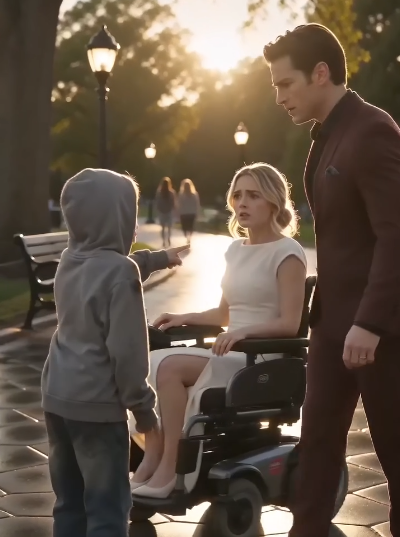
THE BOY SAID THE WOMAN IN THE WHEELCHAIR COULD WALK—THEN HER HUSBAND HEARD WHO SHE PLANNED TO BURY
Richard Hayes had pushed his wife’s wheelchair through the park every evening for nearly two years.
He adjusted her blanket when the air turned cold, carried her up steps when lifts were broken, and abandoned business meetings whenever she called in tears. Victoria had survived the car accident that killed their driver, but doctors said the damage to her spine was permanent.
Richard never complained.
He had built his life around her pain because he loved her.
That evening, the park was quiet after the rain. Sunset burned behind the tall trees while couples walked along the wet cobblestones. Richard was telling Victoria about a charity gala when a boy in a torn grey hoodie suddenly ran into their path.
“Sir, open your eyes!” the boy shouted. “She’s lying to you. She can walk!”
Victoria flinched.
It was a tiny movement, but Richard felt the wheelchair handles tremble beneath his hands.
The boy pointed directly at her.
“I saw her standing.”
Victoria quickly forced a smile.
“Honey, you’re not going to believe this brat, are you?”
Richard looked from his wife to the dirt-covered child. The boy could not have been older than eleven, yet there was nothing playful in his expression.
“My name is Noah Carter,” he said. “And I have proof.”
He held up a cracked phone.
Richard took it.
The video began in darkness. The image shook as though Noah had been hiding behind something. Then the screen cleared, revealing the rear courtyard of an expensive medical rehabilitation centre.
Victoria appeared.
She was not sitting in a wheelchair.
She stepped out of a black car, stood upright and walked across the courtyard without difficulty. Her posture was confident. Her movements were smooth.
Richard stopped breathing.
Victoria leaned forward.
“That could be anyone.”
Then her voice came from the phone.
“The transfer happens Friday,” the recorded Victoria said. “Once Richard signs the medical power of attorney, we move the money out of the foundation.”
A man beside her asked, “And if he refuses?”
Victoria smiled.
“He won’t. He thinks I’m helpless.”
Richard slowly raised his eyes.
Victoria’s face had turned white.
The video continued.
“And the boy?” the man asked.
“His mother already knows too much,” Victoria replied. “Deal with them before the gala.”
Richard almost dropped the phone.
Noah stood perfectly still.
“My mother recorded the first meeting,” he said. “Then she disappeared.”
Victoria’s fear transformed into anger.
“This child is trying to extort us. Call security.”
Richard stepped away from her wheelchair.
“Who is his mother?”
Victoria said nothing.
Noah answered.
“Rachel Carter. She was your wife’s physical therapist.”
Richard recognised the name.
Rachel had worked privately with Victoria for several months after the accident. Then she resigned without explanation. Victoria claimed Rachel had stolen jewellery and fled the state.
Richard had believed her.
He had even signed a complaint that damaged Rachel’s professional licence.
Noah explained that his mother had become suspicious when Victoria repeatedly refused treatment unless Richard was present. One night, Rachel returned to the rehabilitation centre to retrieve medical records and saw Victoria walking alone.
She confronted her.
Victoria begged her to remain silent, claiming she had recovered recently but was terrified Richard would stop loving her if she no longer needed him.
Rachel initially believed her.
Then she discovered the truth.
The accident had injured Victoria, but only temporarily. She regained movement within six months. Instead of telling Richard, she bribed a doctor to falsify her reports. Richard’s guilt and devotion made him easy to control.
Whenever he considered travelling or questioning her expenses, Victoria suffered another conveniently timed “medical crisis.”
But sympathy was only the beginning.
Richard chaired the Hayes Family Foundation, which controlled nearly one hundred and twenty million dollars. Its bylaws prevented Victoria from accessing the funds directly. If Richard were declared medically or mentally incapable, however, his spouse could assume temporary control.
Victoria had begun secretly drugging him with sedatives, then recording his confusion as evidence of cognitive decline.
Her plan was to convince him to sign a medical power of attorney. If he resisted, the corrupt doctor would testify that Richard was becoming unstable.
Rachel found the altered prescriptions and copied the financial documents.
Before she could reach the police, she disappeared.
Noah had spent three weeks moving between shelters and sleeping near the park because Victoria’s associate was searching for him. He followed Victoria whenever she left the house, knowing she sometimes walked in private.
The recording on his phone was the first clear evidence he had captured.
Richard looked at the woman he had married.
“Where is Rachel?”
Victoria’s lips parted, but no answer came.
The man from the recording appeared at the far end of the path.
Noah recognised him immediately.
“That’s him.”
The man began walking faster.
Victoria suddenly rose from the wheelchair.
People nearby stopped.
Richard stared as his supposedly paralysed wife stood before him in her white dress.
“Richard, listen to me,” she said. “Everything I did was because I was afraid of losing you.”
“You drugged me.”
“I protected our future.”
“You threatened a child.”
The man reached inside his jacket.
Noah shouted a warning.
Richard pulled the boy behind him, but before the man could approach, two plain-clothes officers emerged from beside a park bench and restrained him.
Noah had not come alone.
That morning, he had shown part of the recording to Detective Lena Ortiz. She arranged the meeting in the park and placed officers nearby, hoping Victoria would expose herself.
Victoria looked around wildly.
“You set me up.”
“No,” Detective Ortiz said. “A child told the truth, and someone finally listened.”
Police searched Victoria’s estate that evening.
In a locked wine cellar, they found Rachel Carter alive.
She was weak, frightened and chained inside a small storage room, but she had survived. Victoria’s associate had kept her there while trying to discover where she had hidden the copied records.
Rachel had hidden them inside Noah’s school backpack.
The evidence revealed more than fraud.
Victoria had caused the original car accident.
She had been driving the second vehicle behind Richard’s car after arguing with him by telephone. She intended to frighten him into cancelling a meeting with a divorce lawyer. She struck the rear of the car, forcing it through a barrier.
The driver died.
Victoria’s own injuries were real, but after recovering, she turned the tragedy into a weapon. She used Richard’s guilt to stop him from investigating and built an identity around helplessness while quietly preparing to steal his foundation.
The corrupt doctor falsified scans and prescriptions. Victoria’s financial adviser created offshore companies. Her associate kidnapped Rachel and hunted Noah.
All three were arrested.
Victoria tried to claim that trauma had clouded her judgement. The jury rejected it.
She was convicted of conspiracy, fraud, kidnapping, administering drugs without consent and vehicular manslaughter. She received forty-one years in prison. The doctor lost his licence and was imprisoned. The adviser accepted a reduced sentence after helping recover the stolen funds.
Richard faced a different punishment.
He had to live with the knowledge that his unquestioning loyalty had helped Victoria hurt others. He apologised to Rachel for signing the false complaint against her and paid to restore her professional reputation.
Rachel did not forgive him immediately.
“You believed the story that was easiest for you,” she said. “That does not make you cruel, but it does make you responsible.”
Richard accepted that.
Noah and Rachel entered a protection programme until the trial ended. Richard arranged safe housing for them, but he did not try to buy their gratitude. Instead, he asked what they needed and listened to the answer.
Noah needed school.
Rachel needed time.
Richard needed to learn that love without questions could become blindness.
Months later, he met Noah in the same park. The boy wore a clean jacket and carried a new phone, though he still kept the cracked one in his backpack.
“Why do you still carry it?” Richard asked.
“Because everyone thought I was just some dirty kid making trouble,” Noah said. “That phone reminded them I knew what I saw.”
Richard sat beside him on a bench.
“I should have believed you before watching the video.”
Noah looked towards the path where Victoria’s empty wheelchair had once stood.
“Most people don’t believe the truth until it looks expensive.”
Richard never forgot those words.
He transformed the family foundation into an organisation supporting whistle-blowers, missing families and children without stable homes. Rachel later joined its independent board, ensuring no single person could control the money again.
The wheelchair was donated to a rehabilitation centre.
Richard refused to destroy it.
It had never been the source of the lie.
Victoria had used it to make weakness visible while hiding the cruelty no one thought to question.
The real hero had been a frightened boy carrying a broken phone.
Noah did not expose Victoria because he was fearless.
He exposed her because his mother was missing, nobody powerful was searching for her, and he understood that sometimes the only way to make the world see the truth is to stand directly in its path and refuse to move.
