AT 12:04 A.M., THE PHONE RANG—AND THE VOICE TOLD HIM TO HIDE FROM HIS OWN SON-IN-LAW
At precisely 12:04 in the morning, Harold Bennett’s telephone began to ring.
The sound cut through the silent house with such violence that the old man woke believing someone had struck the bedroom door. He reached blindly across the wooden bedside table, knocking over his glasses before finding the glowing screen.
Dominic.
Harold answered with a dry, sleepy voice. “Do you know what time it is?”
“Turn off every light,” Dominic said. “Go to the attic. Lock the door, and do not tell your son-in-law where you are.”
Harold sat upright.
“What are you talking about?”
“Michael is already inside the house.”
The sleep vanished from Harold’s face.
His daughter’s husband had been staying with him for three weeks, supposedly because Harold should not live alone after a recent fall. Michael had cooked his meals, checked his medication and told everyone what a devoted son-in-law he was.
Yet that evening, Michael had said he was driving to the airport.
Harold glanced towards the bedroom doorway.
The hallway beyond it was dark.
“You’re scaring me,” he whispered.
“Do it now.”
Harold ended the call, dragged himself out of bed and hurried into the corridor. His bare feet struck the cold floorboards. He switched off the bedside lamp, then the hallway light and finally the small lamp beside the children’s toys in the living room.
The house disappeared into darkness.
A sound came from the rear entrance.
Not a knock.
A key turning.
Harold froze.
Then he ran.
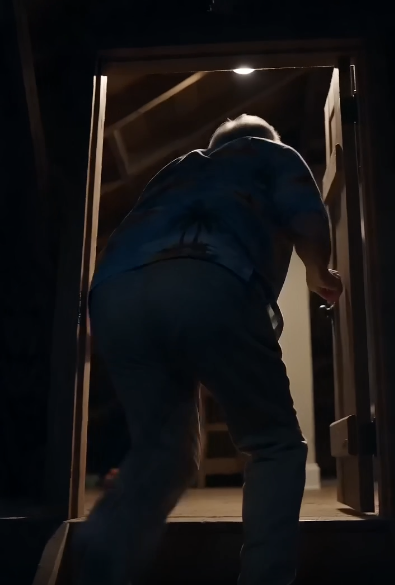
He crossed the living room, nearly tripping over a wooden train that had belonged to his granddaughter, Sophie. At the end of the hall, he pulled open the narrow attic door and climbed the steep steps as quickly as his knees allowed.
He shut the door behind him and pushed the bolt into place.
For several seconds, he heard nothing except his own breathing.
Then the front room floor creaked.
Someone moved through the darkness below.
Harold pressed one eye against the gap beside the attic door. A tall figure appeared at the far end of the corridor. Broad shoulders. Slow, controlled movements. Michael.
He was not carrying luggage.
He was wearing black gloves.
Harold covered his mouth.
Ten years earlier, Harold’s daughter, Emily, had married Michael Grant after a brief courtship. He was charming, attentive and successful, a financial consultant who seemed to know exactly what everyone needed to hear. When Emily became pregnant, Michael persuaded her to leave her job and move away from her family.
Then the calls became less frequent.
Emily always sounded tired. Sometimes frightened.
Three years later, she vanished.
Michael told the police that Emily had left him after an argument. He produced emails in which she supposedly admitted to having another man. A bank withdrawal suggested she had taken cash and fled.
No body was ever found.
Harold had wanted to believe she was alive somewhere. Dominic never did.
Dominic Bennett was Emily’s younger brother. At the time of her disappearance, he had been a police detective. His refusal to abandon the case eventually cost him his badge. He accused Michael publicly, broke into one of Michael’s offices looking for evidence and was dismissed after Michael filed a complaint.
Harold had blamed Dominic for destroying the family’s last chance of reconciliation.
For years, father and son barely spoke.
Then, six months earlier, Dominic telephoned with new information.
A woman in Nevada had disappeared after marrying a man who looked exactly like Michael but used another name. A second woman in Oregon had died in what appeared to be an accidental house fire. Both had large life-insurance policies. Both had transferred property to their husbands shortly before their deaths.
Dominic believed Michael had been marrying vulnerable women, isolating them, stealing their assets and making them disappear.
Emily had been the first.
Harold refused to accept it.
Until he found the key.
It had been hidden beneath the lining of an old sewing box belonging to Emily. Attached to it was a small paper tag bearing two handwritten words:
Sophie’s stars.
Harold recognised the phrase. Emily had painted glowing stars across the attic ceiling for her daughter. Sophie had been only two when her mother vanished, and Michael had later taken the child overseas. Harold had not seen his granddaughter in seven years.
Three nights earlier, he used the key to open a small iron compartment beneath the attic floorboards.
Inside, he found a digital recorder, several passports bearing Michael’s photograph under different names, and a bloodstained necklace that had belonged to Emily.
Harold called Dominic.
Dominic told him not to touch anything else.
The police needed Michael to reveal that he knew the hiding place existed.
So Dominic created a trap.
He sent Michael an anonymous message claiming that Emily’s father had discovered “the box beneath Sophie’s stars” and planned to take it to the police in the morning.
Michael booked the first flight back.
Now he was inside the house.
Below the attic, a drawer opened.
Then another.
Michael searched the kitchen, the study and the old nursery. His movements became faster. Less controlled.
“Harold?” he called softly.
The old man did not answer.
Michael entered the living room.
“I know you’re awake.”
Harold gripped the digital recorder in his hand. Dominic had instructed him to keep it close but never to play it unless Michael confessed.
The attic steps creaked.
Harold’s heart seemed to stop.
Michael was climbing.
The handle turned.
The bolt held.
“Open the door,” Michael said.
Harold remained silent.
Michael’s voice changed.
“You found something that belongs to me.”
Harold closed his eyes.
“Emily belonged to herself,” he answered.
Silence.
Then Michael struck the door so hard that dust fell from the ceiling.
“You have no idea what she did,” he shouted. “She was going to take Sophie and ruin everything.”
Harold’s fingers tightened around the recorder.
“What did you do to my daughter?”
Michael laughed once, but there was no humour in it.
“She would not stop screaming. I only meant to frighten her.”
Harold pressed the recorder’s button.
A woman’s voice filled the attic.
Emily’s voice.
“If anyone hears this, Michael has been using false identities. He takes women’s money. He told me I would disappear like the others. I hid his passports in the attic. If something happens to me, protect Sophie.”
Michael stopped moving.
The recording continued.
Emily described accounts, properties and names. At the end, her breathing became frantic.
“He’s coming upstairs.”
A door slammed in the old recording.
Michael’s voice followed.
“You should have given me the key.”
Then came a scream.
Harold began to cry.
On the other side of the attic door, Michael whispered, “Give me the recorder.”
“No.”
“I can still let you live.”
“No,” Harold repeated. “You cannot.”
Red and blue lights suddenly flashed through the attic window.
Michael turned towards the sound.
The house erupted with shouts.
“Police! Do not move!”
Michael threw himself against the attic door one final time, but officers were already climbing the stairs. He tried to run down, slipped on the narrow steps and was seized before he reached the hallway.
Dominic entered last.
For the first time in years, Harold saw his son not as the angry man who had divided the family, but as the only person who had refused to abandon Emily.
Dominic opened the attic door.
Harold fell into his arms.
“I should have believed you.”
Dominic held him tightly.
“You wanted her to be alive.”
“I wanted the lie more than I wanted the truth.”
Michael Grant was later identified as Nathan Cole, a man wanted under four different names. Investigators connected him to two murders, three disappearances and millions of dollars in stolen insurance and property.
Emily’s remains were found beneath a concrete floor in one of Michael’s former rental houses.
The discovery ended Harold’s hope, but it also ended the uncertainty that had tortured the family for years.
Michael was convicted of Emily’s murder, financial fraud, kidnapping and the killings of two other women. He received life imprisonment without parole.
The passports and recorder from the attic helped reopen several cold cases. Two families finally learned what had happened to their daughters.
Sophie was located living at a private school in Switzerland under a false surname. Michael had told her that her mother abandoned her and that her grandfather was dead.
When Sophie returned, she was twelve years old.
Harold took her to the attic, now filled with daylight. The dust had been cleaned, the broken lock replaced and Emily’s glowing stars still covered the ceiling.
“My mother painted those?” Sophie asked.
“Yes.”
“Did she love me?”
Harold’s voice failed.
Dominic answered for him.
“She loved you enough to leave behind the truth.”
Harold had once believed the attic contained only grief.
Instead, it held the evidence that brought a killer to justice, restored a stolen child to her family and forced an old man to face the painful difference between forgiveness and denial.
At 12:04 that night, Harold had hidden from his son-in-law in terror.
By sunrise, he understood that the most dangerous thing in his house had never been the man searching the darkness.
It was the lie the family had allowed to live there for ten years.
