THE MAID SHATTERED THE GROOM’S DRINK—THEN THE VIDEO EXPOSED WHY THE BRIDE NEEDED HIM DEAD BEFORE MIDNIGHT
The glass broke before anyone understood what was happening.
Orange juice splashed across the white aisle runner as Clara Bennett, one of the wedding hall’s quietest maids, tore the drink from Nathan Whitmore’s hand. Crystal fragments scattered beneath the chandeliers, and the violinist stopped mid-note.
For one breathless second, the entire ballroom froze.
Then the bride struck her.
Vanessa Whitmore’s palm cracked across Clara’s face so hard that the young woman stumbled into a chair. Guests gasped. Clara pressed one trembling hand against her burning cheek while tears gathered in her eyes.
“What kind of rudeness is this?” Vanessa demanded.
Clara looked past her, directly at Nathan.
“Don’t drink it,” she whispered. “Something has been put in it.”
A murmur moved through the room.
Nathan stood rigid in his black tuxedo, still holding the empty stem of the shattered glass. His expression shifted between embarrassment and disbelief.
Vanessa gave a short, humourless laugh.
“She’s lying. She’s been acting strangely all evening.”
Clara reached into her apron.
Several guests recoiled, but she only produced a phone.
“I recorded her,” Clara said.
Vanessa’s face changed.
It was small—only a tightening around the mouth—but Nathan saw it.
Clara unlocked the phone and played the video.
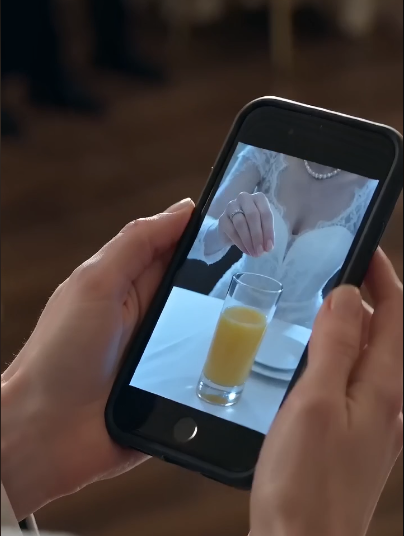
The image showed a private preparation room behind the ballroom. Vanessa stood alone beside a silver drinks tray, still wearing her bridal robe. She removed a white pill from a small envelope, crushed it with the base of a perfume bottle and stirred the powder into a glass of orange juice.
Then she placed a ribbon around the stem.
The same ribbon that had been tied to Nathan’s drink.
Silence swallowed the hall.
Nathan watched the video twice.
When he finally looked at Vanessa, his voice was almost too quiet to hear.
“What did you put in my glass?”
Vanessa’s eyes darted towards the exit.
Before she could move, two men in dark suits stepped into the aisle. They were not guests. They were private security officers hired by Nathan’s father after a series of anonymous threats against the family.
Nathan turned back to Clara.
“How did you know?”
Clara’s lower lip trembled.
“I only wanted to save your life.”
She had worked at the Whitmore estate for eleven months, though almost no one in the family had noticed her beyond polite greetings. She served meals, cleaned guest rooms and cared for Nathan’s elderly grandmother, Evelyn, whenever the private nurses were unavailable.
Evelyn noticed Clara.
Unlike the others, she asked about the young woman’s life. She learned that Clara had once studied nursing before leaving school to care for her sick mother. She also learned that Clara had an unusual surname before marriage records changed it.
Clara Bennett had been born Clara Vale.
Twenty-three years earlier, Nathan’s father had destroyed the Vale family.
Arthur Whitmore, celebrated publicly as a brilliant pharmaceutical executive, had acquired a small research company owned by Clara’s father. The company had developed a promising treatment for a rare heart condition. Arthur stole the formula, forced the Vales into bankruptcy and buried evidence that early trials had caused fatal side effects.
Clara’s father tried to expose him.
He died in what police called a car accident.
Her mother never believed it was an accident.
Clara entered the Whitmore estate hoping to discover the truth. She expected cruelty, arrogance and corruption. Instead, she found Nathan.
He was not like his father.
Nathan had recently taken control of Whitmore Biotech and begun auditing old research programmes. He treated staff with respect, reopened compensation claims for injured patients and quietly planned to hand evidence of historic misconduct to federal investigators.
Vanessa knew.
She had not fallen in love with Nathan by chance.
Before meeting him, she had worked for Arthur Whitmore’s private attorney, Marcus Shaw. Together, Vanessa and Shaw had spent years hiding illegal payments, falsified clinical records and evidence connecting Arthur to the death of Clara’s father.
Nathan’s audit threatened everything.
If the files became public, Arthur would face prison, Vanessa would lose the fortune she expected to inherit through marriage and Shaw’s legal career would end.
So they created another plan.
Nathan’s grandmother had placed the controlling shares of Whitmore Biotech into a family trust. Under its terms, Nathan would gain permanent control at midnight on his wedding day. If he died before then, authority would temporarily return to Arthur until another legal heir was appointed.
Vanessa needed Nathan to marry her.
Then she needed him dead before midnight.
The drug in the drink was designed to trigger a fatal cardiac event that could be blamed on Nathan’s recently diagnosed heart rhythm disorder. Vanessa would become the grieving widow. Arthur would recover control of the company, and the investigation would disappear.
Clara discovered the plan two nights before the wedding.
While cleaning Arthur’s private study, she found a burner phone hidden behind a locked drawer. Messages between Vanessa and Shaw described the dosage, the timing and the medical examiner prepared to certify Nathan’s death as natural.
Clara copied everything.
She tried to warn Nathan that morning, but Vanessa intercepted her outside his suite and threatened to accuse her of theft. Clara knew the family would probably believe the bride over a maid.
So she waited.
When she saw Vanessa preparing the drink, she recorded it.
The wedding guests watched in horror as police arrived. Officers searched Vanessa’s dressing room and found the envelope containing the remaining pills. Marcus Shaw was arrested in the hotel parking garage with forged medical documents and a one-way ticket to Switzerland.
Arthur Whitmore attempted to leave through the kitchen.
Clara blocked the corridor.
For the first time, Arthur truly looked at her.
“You,” he whispered.
“You remember my father,” Clara said.
Arthur denied everything until investigators recovered the burner phone and reopened the Vale case. Traffic-camera archives, hidden financial records and a payment to the mechanic who had altered her father’s brakes proved the crash had been arranged.
Arthur had ordered the killing.
Vanessa had helped conceal it years later.
At trial, the prosecution revealed that Nathan was not the first person they had attempted to silence. Three former researchers had died under suspicious circumstances after threatening to expose the company’s illegal trials.
Arthur received life imprisonment without parole. Vanessa was convicted of attempted murder, conspiracy and evidence destruction. Marcus Shaw was also sentenced to decades in prison.
Nathan survived because he never drank from the glass.
But survival did not erase the humiliation of discovering that his wedding had been designed as an execution.
For months, he withdrew from public life. He cancelled the wedding contracts, dissolved his father’s influence over the company and created an independent fund for victims of Whitmore Biotech’s concealed trials.
Clara testified, then prepared to leave the estate.
She had achieved what she came for. Her father’s name had been cleared, and the people responsible were in prison.
On her final morning, Nathan found her carrying a small suitcase through the servants’ entrance.
“You saved my life,” he said.
Clara lowered her eyes. “I also entered your home under a false name.”
“You entered my home because my family destroyed yours.”
He offered her money. She refused.
He offered her a position in the company’s ethics division. She hesitated.
“I don’t want charity.”
“It isn’t charity,” Nathan said. “You were the only person in that ballroom brave enough to tell the truth.”
Clara accepted on one condition: the company would reopen every patient case connected to the stolen Vale research.
Nathan agreed.
Over the next two years, they worked beside investigators, doctors and grieving families. The company that had once buried suffering began paying for treatment, publishing hidden data and admitting publicly what its founder had done.
Trust between Clara and Nathan grew slowly.
It was not born from rescue or gratitude. It grew through difficult meetings, shared anger and the quiet understanding of two people rebuilding lives shaped by the same man’s cruelty.
One evening, Nathan asked Clara why she had risked everything when she still believed he might be like his father.
She thought for a long moment.
“Because I saw you trying to undo what he had done,” she replied. “And because becoming like him would have meant watching you die.”
Years later, they returned to the same ballroom for the opening of the Vale Medical Justice Foundation.
The chandeliers still glittered. The tables were still dressed in white. But there was no poisoned drink and no bride hiding behind a perfect smile.
Clara stood at the podium, no longer wearing a maid’s uniform.
Nathan sat in the front row beside Evelyn, listening as Clara spoke about the people society overlooks—the staff member in the corner, the patient no one believes, the quiet witness who sees what powerful people assume will remain hidden.
The world later called Clara a hero.
She never accepted the word easily.
She said she had only broken a glass.
But everyone in that room knew the truth.
She had shattered far more than crystal.
She had broken a family’s silence, exposed a murderer and saved a man who had nearly inherited his father’s empire without ever knowing its foundations were built on blood.
And when Nathan looked at her that night, he understood that the person everyone had dismissed as invisible had been the only one brave enough to see him clearly.
