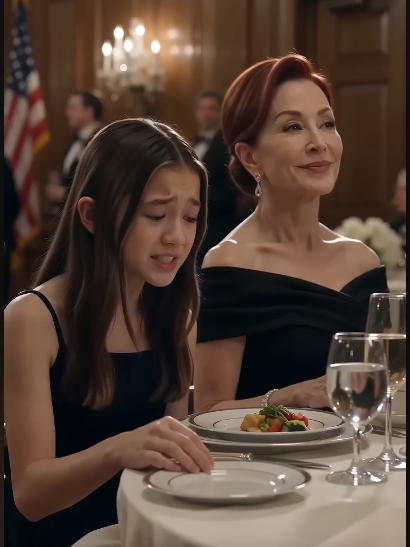
HER MOTHER TRIED TO SECRETLY THROW HER OUT OF THE CHARITY GALA—THEN THE WAITER REVEALED WHO SHE REALLY WAS
Lily had been told not to speak unless someone addressed her first.
She sat beside her mother beneath the ballroom’s warm chandeliers, surrounded by white flowers, silver cutlery, and people whose names appeared on hospital wings and university buildings.
Everyone looked elegant.
Everyone except Lily looked as though they belonged.
She kept her hands in her lap and watched the untouched plate in front of her. Across the room, a large banner announced the evening’s purpose: raising money for children separated from their families.
The irony made her stomach hurt.
“Mom,” Lily whispered, “can I please stay until the speech?”
Margaret did not turn toward her.
She continued smiling at a senator seated nearby.
“You were never supposed to be seen tonight.”
Her hand disappeared beneath the table.
A folded note pressed against Lily’s fingers.
Lily opened it carefully.
SAY YOU’RE SICK. LEAVE NOW.
Her throat tightened.
“Why do you hate me this much?”
Margaret lifted her teacup as if they were discussing the weather.
“Because one mistake can ruin an entire family.”
Lily stared at her.
She had heard herself called a mistake before, but never so clearly.
A young waiter approached carrying a white porcelain teapot.
“More tea, ma’am?”
Margaret nodded without looking at him.
As he poured, his eyes moved to the note beside Lily’s plate. Then he looked at Lily’s trembling hands and swollen eyes.
His polite expression disappeared.
“Miss,” he whispered, “did she write that to you?”
Margaret placed her cup down sharply.
“Walk away, waiter. This is family business.”
The waiter did not move.
Instead, he picked up the note before Margaret could take it.
“No, ma’am,” he said. “This is evidence.”
Conversations faded around them.
Margaret’s face went pale.
The waiter straightened.
“The chairman asked me to find his missing granddaughter.”
He looked at Lily.
“And I think you just tried to throw her out.”
Every guest at the table turned toward them.
Lily’s heart pounded.
“What granddaughter?”
Margaret stood so quickly her chair struck the floor.
“This man is confused. Security should remove him.”
“That won’t be necessary.”
The voice came from the stage.
An elderly man stood beside the podium, one hand resting on a dark wooden cane. His white hair was neatly combed, and though age had curved his shoulders, the room still responded to his presence.
Charles Bennett.
Founder of the Bennett Foundation.
Chairman of one of the largest hotel companies in the country.
Lily had seen his portrait in magazines but never met him.
Charles stepped down from the stage.
His eyes did not leave her face.
“Her name was Elizabeth,” he said softly.
Margaret’s lips tightened.
“Charles, this is neither the time nor the place.”
“I have allowed you to decide the time and place for eighteen years.”
He stopped in front of Lily.
“That ends tonight.”
Lily looked between them.
“Who is Elizabeth?”
Charles’s expression folded with pain.
“My daughter.”
A murmur passed through the room.
Charles explained that Elizabeth Bennett had disappeared nineteen years earlier while pregnant.
She had been twenty-one and planning to leave the country with the baby’s father, a young musician Charles considered unsuitable.
He had reacted badly.
He threatened to cut her off financially and told her she would return home once she understood how difficult life could be without the Bennett name.
She never returned.
Three months later, police found her car abandoned near a bus station.
Margaret, Elizabeth’s older sister, claimed Elizabeth had called and said she wanted no contact with the family.
Charles believed her.
For years, private investigators found nothing.
Then, six months earlier, Charles received an unsigned letter.
Your granddaughter is alive. She has been living closer than you think.
Inside was a photograph of Lily as a baby.
The blanket wrapped around her bore Elizabeth’s embroidered initials.
Charles hired Ethan Cole, a former federal investigator who now handled security for the foundation.
Ethan had spent months tracing hospital files, altered adoption records, and payments made through shell accounts.
Tonight, he had entered the gala disguised as a waiter because Margaret controlled the guest list, the staff, and every person allowed near Charles.
Lily looked at Ethan.
“You knew who I was?”
“I suspected,” he said. “But we needed proof.”
Margaret laughed too loudly.
“This is insane. Lily is my daughter.”
Charles turned toward her.
“Then tell her where she was born.”
Margaret said nothing.
Ethan placed a folder on the table.
The investigation showed that Elizabeth had gone into labor at a private clinic outside the city. She died from complications shortly after giving birth.
The clinic administrator contacted Margaret.
Instead of telling Charles, Margaret paid the administrator to change the records.
She registered the baby as her own child and told everyone she had given birth while living abroad.
For eighteen years, Lily had believed Margaret was her biological mother.
“Why?” Lily asked.
Margaret’s face hardened.
“Because your grandfather had already revised his estate.”
Charles had created a trust for Elizabeth’s child before she disappeared.
If Elizabeth died, her baby would inherit controlling shares of Bennett Hotels upon turning eighteen.
Margaret, as Lily’s legal guardian, would manage the assets until then.
Lily had turned eighteen two weeks earlier.
The gala was meant to announce a major restructuring of the company.
Margaret planned to have Lily declared mentally unfit before anyone discovered her identity. She had collected false medical reports claiming Lily was unstable and incapable of managing an inheritance.
The note ordering her to leave was only part of the plan.
“She has panic attacks,” Margaret said. “She cries constantly. She cannot survive in this world.”
Lily stared at her.
“You told me I was sick.”
“I protected you.”
“You made me afraid of everyone.”
Margaret reached for her arm.
Lily pulled away.
Ethan opened another file.
Bank statements showed that Margaret had already transferred millions from Lily’s trust into private investment accounts.
She had also paid the clinic administrator for years to remain silent.
That administrator had recently confessed after being diagnosed with a terminal illness.
The unsigned letter had come from him.
Margaret looked toward the exits.
Two uniformed officers entered the ballroom.
“This is a misunderstanding,” she said. “My attorneys will explain everything.”
Charles stepped between her and Lily.
“You stole my granddaughter’s name, her inheritance, and every chance she had to know her mother.”
“I raised her.”
“You controlled her.”
Margaret’s composure broke.
“Elizabeth humiliated this family. She chose poverty and scandal over us. I repaired the damage.”
Charles’s hand tightened around his cane.
“My daughter died believing her family had abandoned her.”
He looked at Lily.
“And this child grew up believing she had to apologize for existing.”
Margaret was arrested for fraud, identity falsification, theft, conspiracy, and abuse of a dependent adult.
The guests watched in silence as she was escorted through the same ballroom she had tried to remove Lily from.
Lily did not feel victorious.
She felt empty.
Charles offered to take her home that night, but Lily shook her head.
“I don’t know you.”
His eyes filled.
“I understand.”
“No,” she said. “I don’t think you do. Everyone in this room knows more about my life than I do.”
Charles lowered his head.
“You’re right.”
He did not ask her to call him Grandfather.
He arranged a hotel suite in Lily’s name, hired an independent attorney for her, and gave her full access to every document connected to Elizabeth.
Ethan stayed nearby, not as an investigator, but as the first person Lily trusted enough to call when the nightmares came.
Recovery was slow.
Lily learned that many of her “symptoms” had been responses to years of emotional control. Margaret had isolated her, monitored her phone, and punished any attempt at independence.
Therapy helped her separate fear from truth.
Charles visited once a week.
Sometimes they spoke.
Sometimes they sat quietly while Lily read her mother’s letters.
He never defended his past.
“I failed Elizabeth,” he told her. “I won’t insult you by pretending otherwise.”
Months later, Lily entered Bennett Hotels for the first time as a shareholder.
She did not take Margaret’s old office.
She converted it into a support center for young adults escaping controlling families.
At the following year’s charity gala, Lily stood at the podium where Charles had revealed the truth.
She wore the same black dress.
This time, her shoulders were straight.
“My mother was called a mistake,” she told the audience. “Then I was raised to believe I was one too. But children do not inherit the shame of the people who hurt them.”
Charles watched from the front table.
Ethan stood near the doors, no teapot in his hands.
When Lily finished, the room rose in applause.
She found Charles afterward.
“Grandpa,” she said.
He closed his eyes for a moment.
It was the first time she had called him that.
Lily had entered the ballroom believing her mother wanted her hidden because she was an embarrassment.
She left knowing Margaret had hidden her because she was the rightful heir.
But the greatest thing Lily recovered was not a fortune or a famous name.
It was the understanding that she had never been the mistake.
She had been the truth everyone else was afraid to face.
