SHE SHOVED THE BRIDE INTO A GLASS DOOR—THEN DISCOVERED THE BOUQUET HAD RECORDED EVERY WORD
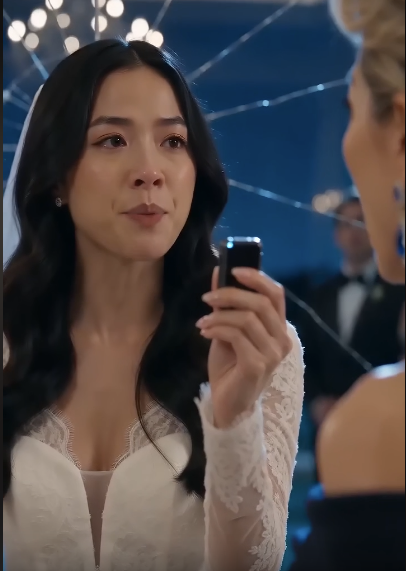
The first crack appeared behind Isabella’s shoulder.
A thin white line spread across the glass door, branching outward until it resembled ice beneath pressure.
The ballroom went silent.
Isabella stood with her back against the damaged glass, one hand gripping her bouquet and the other pressed to the place where Vivian had shoved her.
Her wedding dress remained perfectly white.
Nothing else about the moment felt clean.
Vivian Mercer stood before her in a black evening gown, breathing hard but smiling as though she had merely corrected a servant.
“A girl like you will never wear our family name.”
Several guests looked down at their champagne glasses.
Others turned toward Adrian, waiting for the groom to defend the woman he had married less than an hour earlier.
He did not move.
He stood near the head table, face pale, caught between his mother and his bride.
Vivian took another step toward Isabella.
“My son deserves a legacy,” she said. “Not a charity case.”
Isabella’s fingers tightened around the white roses.
She had spent months preparing for those words.
Still, hearing them in front of two hundred guests hurt more than she had expected.
Vivian pointed toward the doors.
“You thought a white dress could hide where you came from?”
Isabella lowered her head.
To the guests, she looked defeated.
Only Adrian noticed that her hand had moved inside the bouquet.
“You said the same thing before the vows,” Isabella whispered.
Vivian laughed.
“And I’ll say it louder, so every person here understands.”
Isabella separated the roses.
A small recording device rested beneath the petals, its red light blinking steadily.
When she lifted it, Vivian’s smile disappeared.
“Perfect,” Isabella said. “The family lawyer needed your voice, not mine.”
Vivian stared at the device.
“Give that to me.”
Isabella stood straighter despite the pain in her shoulder.
“No. You already gave me everything I needed.”
A murmur moved through the ballroom.
Adrian finally stepped forward.
“Isabella,” he said carefully, “what is this?”
She looked at him.
“This wedding is paused until everyone hears the truth.”
Vivian turned toward her son.
“She is staging this. I warned you she wanted our money.”
Isabella handed the recorder to a silver-haired woman seated near the front.
Margaret Ellis, the Mercer family’s attorney, rose and connected it to the ballroom’s sound system.
Vivian’s voice filled the room.
The first recording had been made three weeks earlier.
“You will sign the agreement before the ceremony,” Vivian said. “If Adrian dies, leaves you, or discovers what you are, you walk away with nothing.”
Then came Isabella’s voice.
“What do you mean by ‘what I am’?”
“A liability. A girl from foster care with no family, no name, and no proof of where she belongs.”
The recording continued.
Vivian admitted she had ordered investigators to search Isabella’s childhood. She had contacted former foster parents, paid a journalist to prepare a story portraying Isabella as unstable, and arranged for altered medical records to be released if Isabella refused to sign a secret prenuptial agreement.
Adrian looked at his mother.
“You told me she requested the agreement.”
Vivian’s face hardened.
“I was protecting you.”
The next recording began.
This time, Vivian was speaking with Adrian’s uncle, Thomas Mercer.
Once Adrian married, control of the Mercer Foundation would transfer to him under the terms of his grandfather’s will. His spouse would receive an equal vote on the foundation’s board.
Vivian had controlled the charity for twelve years.
An independent spouse could inspect its accounts.
That was what she feared.
The recording revealed that millions of dollars supposedly donated to children’s homes had been transferred into consulting companies owned by Thomas.
Isabella covered her mouth when she heard the amounts.
She had grown up in one of the homes named in the records.
The building had gone winters without reliable heating while the Mercer Foundation publicly claimed to have funded a complete renovation.
Adrian’s expression changed.
“This was never about her background.”
Margaret shook her head.
“No. It was about keeping her away from the accounts.”
Vivian reached for the recorder, but hotel security stepped between them.
She turned on Isabella.
“You planned this from the beginning.”
“No,” Isabella said. “I began recording after you threatened to have me declared mentally unstable.”
The guests reacted sharply.
Adrian looked at Isabella.
“She did what?”
Isabella removed a folded letter from inside her bouquet.
It was an evaluation signed by Dr. Russell Kane, the Mercer family physician. The report claimed Isabella suffered from delusions, impulsive behavior, and an obsession with marrying into wealth.
She had never met Dr. Kane.
Vivian had planned to use the report after the wedding. If Isabella discovered the missing foundation money, Vivian would claim her accusations were symptoms of mental illness.
The goal was to isolate her from Adrian and remove her from the board before she could request an audit.
“I found the report in your mother’s study,” Isabella told him. “I brought it to Margaret.”
Adrian’s eyes moved toward the attorney.
Margaret nodded.
“We began an independent investigation.”
For six weeks, Isabella had pretended she knew nothing. She endured Vivian’s insults, demands, and threats while investigators traced the stolen donations.
The bouquet recorder was meant to capture one final admission.
It had captured something else as well.
Vivian confessing that Adrian’s father had discovered the fraud before his death.
“He wanted to report us,” Vivian’s recorded voice said. “So Thomas changed his medication. By the time Adrian questioned anything, grief had made him obedient.”
Adrian stumbled backward.
His father had died eighteen months earlier after collapsing in his study.
The death had been ruled a heart attack.
“Changed his medication?” Adrian whispered.
Vivian looked toward Thomas.
That single glance was enough.
Thomas pushed through the guests and ran for the side exit.
Security stopped him before he reached it.
Margaret signaled to two detectives who had been waiting in a private room nearby.
They entered the ballroom with additional officers.
Vivian’s confidence finally broke.
She turned to Adrian.
“Your father was destroying everything we built. The company, the family name, your future—”
“You mean your control,” Adrian said.
“I did this for you.”
“No.” His voice shook. “You did it so I would never learn to live without your permission.”
Vivian looked at Isabella.
“She manipulated you against your own mother.”
Isabella’s eyes were still wet.
But she did not lower them.
“I didn’t make him hear your voice.”
The detectives arrested Thomas for financial fraud, conspiracy, and suspected involvement in Adrian’s father’s death.
Vivian was arrested for fraud, coercion, falsification of medical records, obstruction of justice, and assault.
As an officer took her arm, Vivian looked at the cracked glass behind Isabella.
“You have ruined this family.”
Adrian stepped beside his bride.
“No. She stopped you from ruining anyone else.”
The guests remained silent as Vivian was escorted from the ballroom.
Only after the doors closed did Isabella begin trembling again.
Adrian reached for her.
She stepped back.
The movement hurt him, but he stopped immediately.
“You stood there,” she said.
He looked toward the floor.
“I know.”
“When she pushed me, you stood there.”
“I thought if I challenged her, everything would get worse.”
“For whom?”
He had no answer.
Isabella removed her wedding ring.
The room seemed to hold its breath.
“I love you,” she said. “But love cannot be built around the hope that someday you’ll defend me.”
Adrian’s eyes filled.
“Are you leaving?”
“I’m pausing the wedding.”
“We already said the vows.”
“Then I’m pausing the marriage.”
She placed the ring in his hand.
“Until I know whether you can become a husband without remaining her frightened son.”
Isabella walked out through a different door.
Not the one Vivian had ordered her to use.
In the months that followed, the Mercer Foundation underwent a complete audit. Stolen funds were recovered, and several executives were charged.
The investigation into Adrian’s father revealed that Thomas had replaced his heart medication with pills that weakened him. Vivian had known and helped conceal the evidence.
Both were eventually sentenced to prison.
Isabella used her new position on the foundation’s temporary oversight board to redirect the recovered money to the children’s homes that had been neglected.
She returned to the foster home where she had grown up.
The heaters were replaced first.
Adrian entered therapy and resigned from the family company’s executive board until he understood how thoroughly his mother had controlled his choices.
He did not send Isabella expensive gifts.
He wrote letters without asking her to return.
In the first, he apologized for freezing when she needed him.
In the second, he admitted he had mistaken silence for peace.
In the third, he wrote:
I thought protecting our family meant preventing conflict. You taught me that sometimes conflict is the only thing standing between cruelty and another victim.
One year after the wedding, Isabella returned to the same ballroom for the Mercer Foundation’s first public accountability event.
The cracked glass door had been replaced.
She asked the hotel to preserve one small piece of the original glass.
It sat inside a frame near the stage.
Beneath it were the words:
WHAT BREAKS IN PUBLIC CAN STILL HEAL IN TRUTH.
Adrian waited in the back row.
He did not approach her until she crossed the room herself.
“I’m not ready to forget,” she said.
“I’m not asking you to.”
“I may never trust you the way I did before.”
“Then I’ll build something new, or accept that I lost the chance.”
Isabella studied him.
For once, there was no desperation in his face and no expectation that she would rescue him from the consequences of his silence.
She took the wedding ring from her bag.
But she did not put it on.
“Coffee,” she said. “That’s all I can promise.”
Adrian nodded.
“That’s more than I deserve.”
They walked out together, leaving space between them.
Vivian had believed Isabella’s lack of a powerful family made her easy to erase.
Instead, the girl she called a charity case became the person who exposed stolen millions, uncovered a murder, and returned dignity to children whose suffering had funded a luxurious lie.
The recording device inside the bouquet did more than capture Vivian’s cruelty.
It preserved the moment Isabella stopped begging to be accepted by a powerful family—and forced that family to answer for what it had become.
