THEY ACCUSED HER LITTLE BOY IN FRONT OF THE WHOLE FAMILY… BUT HIS MOTHER HAD ALREADY SEEN THE SECURITY FOOTAGE
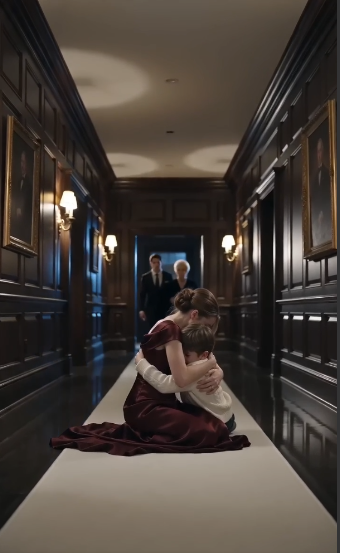
Isabella was already on her knees when the first accusation landed. The whole Whitmore family stood in the mansion hallway as if they had gathered for a trial instead of Sunday dinner. At her feet, a shattered crystal decanter glittered across the white carpet, its dark red wine spreading like a wound. In her arms, her seven-year-old son Noah shook so violently that his small fingers dug into the sleeve of her dress. “Mommy,” he sobbed against her neck, “I didn’t take it. I didn’t break it.”
Across the hallway, Charles Whitmore stood silent, caught between the woman he had married and the family he had spent his life obeying. Behind him, his mother, Margaret, rested a perfectly manicured hand on his shoulder. She wore the calm expression of a woman who had not discovered a disaster but arranged one. “Children lie when they are frightened,” Margaret said softly, though everyone heard her. “Especially children who have been raised without discipline.”
Isabella looked up. Her face was wet with tears, but her eyes had changed. The hurt was still there, deep and bright, yet something colder had risen beneath it. “Be careful,” she said. “You are talking about my son.”
Margaret sighed, as if patience itself had exhausted her. “Your son was seen near the display cabinet. The heirloom decanter is broken. My diamond brooch is missing from the same table. What else should we believe?”
Noah pulled back just enough to look at his father. “Daddy, please. I didn’t.”
Charles opened his mouth, but no words came. That silence hurt Isabella more than any accusation. For two years, she had endured Margaret’s polite cruelty: the comments about her modest background, the way servants suddenly forgot her preferences, the way family dinners became performances where Isabella was always the outsider and Noah was always treated like a guest who had overstayed.
But this was different. This was not an insult. This was a trap.
Margaret turned to the relatives gathered near the staircase. “I warned Charles that bringing another man’s child into this family would bring trouble.”
The sentence split the air.
Isabella slowly stood, still holding Noah close. “Say that again,” she whispered.
Charles finally moved. “Mother, stop.”
But Margaret had gone too far to retreat. “No. This family has protected its name for generations. That boy is not Whitmore blood. And now he steals from us.”
Noah buried his face in Isabella’s shoulder and made a sound no child should ever make in a room full of adults. Isabella kissed his hair once, gently, then looked straight at Margaret. “You should have checked the security cameras.”
For the first time that evening, Margaret’s face lost its colour.
The hallway went silent.
Charles turned sharply toward his wife. “What do you mean?”
Isabella did not answer him at first. She took Noah’s hand and walked to the small sitting room beside the hall, where an antique television screen had been fitted into a modern security console. The mansion’s cameras were usually monitored by staff, but Isabella had learned months earlier that Margaret liked blind spots. After one of Noah’s toys had been mysteriously crushed in the garden and blamed on him, Isabella had quietly asked the estate technician to restore the hallway camera feed to her phone. She had said nothing. She had waited.
Now she pressed play.
The screen flickered to life. The footage showed the hallway twenty minutes before the family had been called in. Noah appeared first, walking carefully past the display table with a toy car in his hand. He stopped, admired the crystal decanter without touching it, then hurried away when Margaret entered from the opposite corridor.
Margaret stood alone by the table.
No one breathed.
On the screen, she removed her diamond brooch from her jacket and slipped it behind a cushion on the hallway bench. Then she lifted the decanter, hesitated, and let it fall. The crystal burst across the carpet. Wine spilled everywhere. Margaret stepped back from the mess, expressionless. A moment later, she picked up Noah’s toy car from where he had left it near the wall and placed it beside the broken glass.
Charles stared at the footage as if the ground beneath him had vanished. “Mother…”
Margaret’s hand tightened around the pearls at her throat. “That is not what it looks like.”
Isabella let out a small, bitter laugh. “Then explain what it is.”
But the footage was not finished.
A second clip appeared, recorded from the nursery corridor two nights earlier. Margaret was speaking with Daniel, Charles’s younger brother, near the study door. Her voice, usually smooth as silk, was sharp and low. “Once Isabella is gone, Charles will stop playing house. The trust cannot pass through that woman or her boy. The board is already worried about his judgement. We only need one public scandal to make him listen.”
Daniel looked uneasy. “Framing a child is too much.”
Margaret replied, “A child is the easiest person to frame. Everyone believes they panic and lie.”
In the sitting room, Daniel lowered his head. His wife stepped away from him as if shame itself were contagious.
Isabella paused the video. Her voice shook, but it did not break. “The secret was never a broken decanter. It was the trust.”
Charles turned toward Margaret, horror rising in his face. Isabella had not known the full truth until that afternoon, when the estate lawyer, disturbed by Margaret’s recent questions, had called her privately. Charles’s grandfather had changed the family trust years ago. If Charles remained married, his household, including any legally adopted child, would be protected from Margaret’s control. Charles had begun adoption papers for Noah in secret as a birthday gift. Margaret had found out.
She did not simply hate Isabella. She feared losing power.
Charles walked toward Noah and dropped to one knee. “Noah,” he said, his voice breaking, “I am so sorry. I should have believed you immediately.”
Noah looked at him through swollen eyes. “You thought I was bad.”
Charles flinched as if struck. “No. I was weak. And I will never let anyone hurt you like this again.”
Margaret straightened, trying to gather the room back under her command. “Charles, do not humiliate this family over a woman who manipulated you.”
But Charles stood. Something old and obedient had finally died in him. “The only person who humiliated this family is you.”
By midnight, the family lawyer had been called. By morning, the police had reviewed the footage. Margaret was charged with filing a false theft report, destruction of property, coercion, and conspiracy to interfere with the family trust. Daniel, who had known enough to stop her and chosen silence, resigned from the company board. The servants who had been ordered to lie gave statements. The relatives who had watched Noah cry without defending him left the mansion with their heads lowered.
Margaret was not dragged away screaming. That would have been too human. She walked out stiffly between two officers, still pretending dignity was the same as innocence. At the front door, she looked back at Charles. “You will regret choosing them.”
Charles took Isabella’s hand and placed his other hand on Noah’s shoulder. “No,” he said. “I regret not choosing them sooner.”
Weeks later, the hallway carpet was replaced, but Isabella kept one tiny piece of broken crystal in a velvet box, not as a memory of pain, but as proof that truth can survive even in a house built on silence. Charles completed Noah’s adoption in a quiet courtroom where the boy wore a navy suit and held Isabella’s hand so tightly she could feel his heartbeat. When the judge asked if he understood what adoption meant, Noah looked at Charles and whispered, “It means he stays my dad forever.”
Charles cried before Isabella did.
That evening, back at the mansion, there was no grand dinner, no performance, no cold matriarch watching from the head of the table. There was only soup on the stove, Noah’s laughter from the hallway, and Isabella standing in the doorway, watching her son race his toy car across the polished floor without fear.
For the first time, the mansion felt less like a museum of wealth and more like a home. Isabella had not saved her son by shouting the loudest. She had saved him by seeing what everyone else refused to see, by trusting the trembling voice that said, “I didn’t do it,” and by understanding that a mother’s tears are sometimes not surrender. Sometimes they are the beginning of justice.
