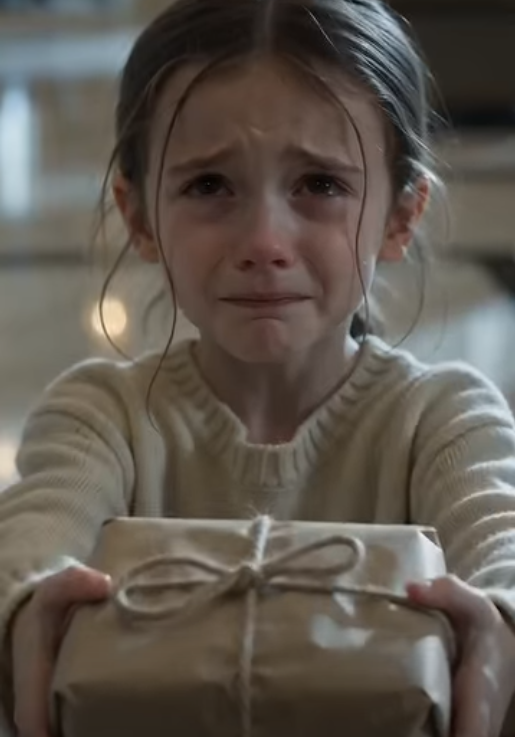
SHE KNOCKED A LITTLE GIRL’S GIFT INTO THE TRASH… THEN HER FATHER FOUND THE SECRET HIDDEN INSIDE
The gift landed beside the trash can with a small, heartbreaking thud. It was not wrapped in gold paper. It had no velvet ribbon, no expensive card, no polished box from a luxury store. It was only a crooked little package wrapped in old brown paper and tied with rough string, but to six-year-old Emma Whitmore, it was the most precious thing in the world. She stood in the cold marble hallway of her grandmother’s mansion with both hands still lifted, staring at the gift as if her whole heart had fallen with it.
Margaret Whitmore walked past without even looking ashamed. Her pearl earrings swayed, her diamond rings flashed under the chandelier, and her bright silk jacket seemed almost cruel against the child’s pale cotton dress.
“Stop making a scene,” Margaret said. “Your father does not need another useless little thing.”
Emma’s lips trembled. She had spent all morning making that gift. She had hidden under the breakfast table with crayons, folded the paper three times because it kept tearing, and tied the string with fingers too small to make a proper knot. She had been nervous, but hopeful. Daniel, her father, had been sad for so long, and she thought maybe one small present could bring back the smile she barely remembered.
Daniel Whitmore stood frozen in front of her. He had been bending down to receive the gift when his mother knocked it from Emma’s hands. His hand remained in the air, empty. He looked at the package beside the trash can, then at his daughter’s face, and something inside him tightened painfully.
“Mother,” he said quietly, “why would you do that?”
Margaret turned with a cold sigh. “Because someone in this house must teach her not to cling to sentimental nonsense. She is a Whitmore. She needs discipline, not cheap drawings and tears.”
Emma let out a broken sob.
Daniel dropped to his knees. “Emma, sweetheart, come here.”
But Emma did not run to him. She ran to the trash can. She picked up the crumpled package with shaking hands and held it against her chest as if Margaret might strike it away again. Her tears fell onto the brown paper.
“I made it for Daddy,” she whispered. “I tried really hard.”
The words cut through Daniel more sharply than anger could. He saw the way Emma’s shoulders curled inward, the way she had learned to apologise for loving too much. For months, he had watched his daughter grow quieter in that mansion. Since his wife, Olivia, disappeared from their daily life, the house had filled with Margaret’s rules, Margaret’s opinions, Margaret’s cold version of dignity. Daniel had believed silence was keeping peace. Now he saw that silence had only taught his child to suffer politely.
“May I see it?” he asked softly.
Emma hesitated, then nodded.
Daniel took the package from her as if it were made of glass. He untied the loose string and opened the brown paper. Inside was a drawing on wrinkled white paper. The lines were crooked, the colors uneven, and the red heart at the top was much too large. Beneath it stood three stick figures holding hands: Daddy, Mommy, and Emma. Above them, in shaky letters, she had written: Please come home, Mommy.
Daniel stopped breathing.
Margaret looked over his shoulder and gave a short, contemptuous laugh. “It is just a childish mess.”
Daniel lifted his head slowly. His eyes were red now, not only with grief, but with fury.
“Our daughter drew this for us,” he said, his voice breaking. “She is begging for her mother, and you call it a mess?”
Margaret’s face hardened. “Her mother abandoned this family. The sooner the child accepts that, the better.”
Emma suddenly shook her head. “Mommy didn’t abandon me.”
Daniel turned to her. “What did you say?”
Emma clutched the drawing. “Mommy comes to the gate. Grandma tells the guards not to let her in.”
The hallway went silent.
For the first time, Margaret’s expression changed. It was only a flicker, but Daniel saw it. Fear. Not regret. Fear of being discovered.
“Emma,” Daniel said carefully, “how do you know that?”
The little girl wiped her cheeks. “I saw her from the upstairs window. She was crying. She had a blue coat. She kept saying my name. Then Grandma closed the curtains and said good girls don’t ask for people who leave.”
Daniel slowly stood, the drawing still in his hand. “Mother.”
Margaret straightened. “Do not take the word of a child over mine.”
Before Daniel could answer, Mrs. Hale, the housekeeper, appeared at the end of the hallway. She had been watching with tears in her eyes.
“It is true, Mr. Whitmore,” she said.
Margaret snapped, “Be silent.”
Mrs. Hale trembled, but she did not step back. “No. Not anymore. Mrs. Olivia came many times. Your mother ordered the guards to turn her away. She told us if we gave you her letters, we would lose our jobs.”
Daniel’s voice dropped to a whisper. “Letters?”
Mrs. Hale looked toward the antique cabinet near the staircase. “In the locked drawer. I am sorry. I should have told you sooner.”
Daniel crossed the hallway in three long strides. Margaret moved to stop him, but he pushed past her and pulled open the drawer with such force that the old lock cracked. Inside lay dozens of envelopes tied together with a white ribbon. Every one of them was addressed to him. Every one was written in Olivia’s familiar handwriting.
He opened the first.
Daniel, I did not leave you. Your mother told me you wanted the divorce and never wanted to see me again. Please let me see Emma. Please ask her if she still remembers the song I sang at night.
His hands shook as he opened another.
I came to the gate today. I saw Emma at the window. They pulled the curtains before I could wave. Daniel, please. Whatever your mother told you, it is not true.
Daniel turned toward Margaret, his face pale with shock. “You kept her from us.”
Margaret’s chin lifted, though her hands were trembling. “I protected the Whitmore name. Olivia was not from our world. She made you weak. She made this house soft.”
“No,” Daniel said. “She made it human.”
Emma cried harder, and Daniel pulled her into his arms. “I am so sorry,” he whispered into her hair. “I should have listened. I should have looked harder.”
That evening, Daniel drove Emma across town to a small apartment building where Olivia had been living alone for two years. When Olivia opened the door, she looked thinner, older, and tired in a way that made Daniel hate every day he had wasted. But when she saw Emma, her face collapsed.
“Mommy!” Emma cried.
Olivia fell to her knees just in time to catch her daughter. They held each other so tightly that Daniel had to turn away for a moment, ashamed of his own tears. Then Olivia looked up at him.
“I never left,” she said.
“I know now,” Daniel replied. “And I am sorry.”
The truth did not heal everything in one night, but it opened the door. Margaret was removed from control of the family estate. Daniel dismissed the guards who had obeyed her orders and cut her access to the trust she had used to rule the household. She remained in the mansion she had chosen over love, surrounded by chandeliers, marble, and the silence she had created.
Months later, Emma’s drawing was framed in the living room of Daniel and Olivia’s new home. The paper was still wrinkled, the heart still too big, and the stick figures still crooked. But every night, Emma passed it holding both her parents’ hands.
The gift Margaret called worthless became the truth that brought a family back together. Sometimes a child’s drawing is not a childish mess. Sometimes it is the only map that can lead love home.
