THE LAST SPOON OF RICE THAT EXPOSED THE WOMAN WHO FRAMED HER
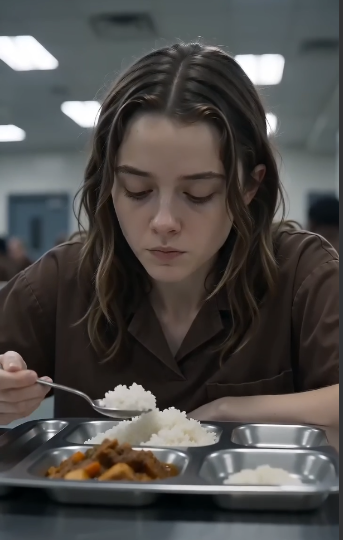
Emily Carter did not move when the rice hit her hair. She sat in the middle of Hollowgate Women’s Prison cafeteria with white grains scattered across her shoulder, her spoon frozen above a dented metal tray, while every woman around her waited to see whether the quiet girl would finally break. For six months, she had swallowed insults the way she swallowed prison food: silently, painfully, because silence was the only thing she had left. Outside those walls, newspapers had called her the “Rice Bowl Killer”, the young wife who poisoned her wealthy husband, Daniel Carter, during supper. Inside, the name followed her like a curse. But that afternoon, when Brenda Knox leaned over her with a cruel smile and said, “Clean my shoe with that rice,” Emily heard something in the woman’s voice that made her blood turn cold.
It was not the insult. It was the sentence. Those exact words had appeared on the anonymous note left on Emily’s kitchen counter the night Daniel died: Rice is for eating, not for begging. The police had dismissed it as nonsense, perhaps written by Emily herself in panic. Emily had remembered every stroke of it because it was the last thing she saw before officers dragged her from her own home. Now, in a prison cafeteria, the same rhythm came out of Brenda Knox’s mouth as naturally as breathing.
Brenda was tall, broad-shouldered, and feared by almost everyone in Hollowgate. She ruled the cafeteria like it was her private court. Emily, small and pale in her brown uniform, had been her favourite target from the first week. Brenda mocked her trial, mocked her dead husband, mocked the fact that Emily’s little sister had stopped visiting because reporters camped outside their mother’s house. Every laugh in that room had taught Emily to make herself smaller. But not today.
Brenda flicked another pinch of rice at her face. “What’s wrong, princess? Poison in this batch too?”
A few inmates laughed. Others looked away, ashamed but afraid. Emily slowly lowered her spoon. The metal touched the tray with a sharp click that seemed louder than the entire room. She lifted her eyes, and for the first time, Brenda’s smile twitched.
“Rice is for eating,” Emily said quietly, “not for begging.”
The cafeteria fell silent.
Brenda’s face changed so quickly that only Emily saw it. The arrogance vanished for half a second, replaced by naked alarm. Then anger rushed in to cover it. Brenda raised her hand, but before she could slap her, Emily stood, stepped aside, and pulled the tray just enough for Brenda’s heavy boot to slide on the spilled rice. Brenda crashed to the floor, the sound echoing between the metal tables. Gasps filled the room.
Officer Hayes rushed in, whistle between her lips, hand on her radio. “Enough!”
Brenda scrambled up, red with humiliation. “She attacked me!”
Emily did not look at the officer. She kept her eyes on Brenda. “Ask her how she knew the note.”
The words cut deeper than the fall. Brenda stopped moving.
Officer Hayes had worked prisons for twenty-three years. She had heard every lie, every plea, every desperate claim of innocence. But Emily’s voice was not desperate. It was steady, almost frighteningly calm. Hayes stepped closer. “What note?”
“The note in my kitchen,” Emily said. “The one they found beside Daniel’s bowl. It said, ‘Rice is for eating, not for begging.’ That detail was never printed in the papers.”
Brenda laughed too loudly. “You’re mad. Everyone knows your story.”
“No,” Emily said. “They know the headline. Not that line.”
Officer Hayes looked from one woman to the other. Then she ordered the cafeteria cleared.
By evening, Brenda Knox was no longer laughing. She sat in an interview room with two investigators, Officer Hayes, and a recorder blinking red on the table. At first, she denied everything. She said Emily was making it up. She said prison gossip twisted facts. But Hayes had already pulled the old case file. The note had indeed been sealed evidence. Not one article mentioned the wording. Not one television report had shown it.
Then investigators found the second crack. Brenda had once worked for a catering company hired by the Carter family for charity dinners. She had also received three payments from a shell account two weeks before Daniel Carter’s death. The account led to Daniel’s older brother, Marcus Carter, the man who inherited the company after Daniel died and who had stood in court with wet eyes, calling Emily “a jealous, unstable wife”.
The truth unravelled fast after that.
Marcus had been stealing from the Carter family business for years. Daniel had discovered the missing money and planned to report him. But Marcus knew the public would believe a story about a young wife, a troubled marriage, and a poisoned dinner. He paid Brenda, who had access to the house through a catering job, to plant the poison in Daniel’s rice and leave a strange note that would make Emily look unstable. Brenda had done it for money and protection, believing Marcus would help reduce her sentence in an unrelated assault case if she were ever caught.
But Brenda’s pride ruined them both. She had repeated the secret line because she wanted to hurt Emily in the most personal way possible. She had not realised that cruelty sometimes opens the door truth has been waiting behind.
Two weeks later, Emily walked back into court wearing a plain grey dress instead of prison brown. Her mother sat behind her, crying into a handkerchief. Officer Hayes, off duty, sat in the last row. Brenda testified in chains, her voice shaking as she admitted Marcus had paid her. Marcus Carter stared at the floor as the judge ordered his arrest. The room stirred, not with gossip this time, but with shame.
When the conviction was overturned, Emily did not smile at first. She simply closed her eyes. Freedom, after being stolen, does not return like sunlight. It returns like breath after drowning.
Outside the courthouse, reporters shouted questions. Emily ignored most of them. Then one asked, “What do you want people to remember?”
She turned, calm and thin but unbroken. “That quiet people are not empty,” she said. “Sometimes they are only waiting for the truth to become louder than the lie.”
Months later, Hollowgate cafeteria changed one small rule. No inmate was allowed to throw food again without immediate discipline. Officer Hayes made sure of it. And Emily Carter, finally home, cooked rice for her mother on a rainy Sunday evening. She set two bowls on the table, held the spoon for a moment, and cried softly, not from fear this time, but because the sound of metal touching porcelain finally belonged to a kitchen, not a prison.
The last spoon of rice had not broken her. It had exposed the woman who framed her, revealed the brother who murdered for money, and returned Emily to the life they had tried to bury.
