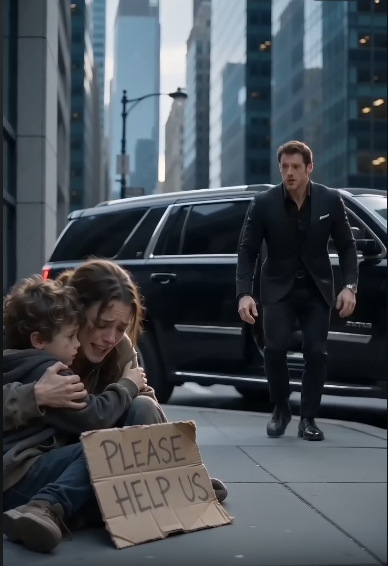
THE MILLIONAIRE SAW A HOMELESS MOTHER BEGGING WITH TWINS ON THE SIDEWALK, THEN REALISED THE BOYS HAD HIS FACE
Marcus Whitmore was stepping out of his black SUV when the past reached up from the pavement and grabbed him by the throat. It was a cold afternoon in downtown Chicago, the kind of cold that slid between glass towers and made everyone walk faster, heads down, collars raised, hearts carefully shut. He had just finished a private meeting about a hotel acquisition worth more money than most people would see in three lifetimes. His driver opened the door. His assistant was already reading the next appointment. Marcus adjusted the cuff of his black suit, glanced toward the corner, and stopped breathing.
A woman sat huddled against the side of a building, her clothes dirty and worn, her brown hair tangled around a face that looked as if sleep had abandoned it weeks ago. She held two little boys close to her chest, one under each arm, as though the city might snatch them away if she loosened her grip. In front of them lay a piece of cardboard shaking in the wind. PLEASE HELP US. People passed without slowing. Some looked away. Some did not look at all.
Marcus would have walked past too. That was the terrible truth he would later admit only to himself. He had trained himself to see poverty as background noise, another sad shape in the city. But then the woman lifted her head, and the world he had built so carefully split open.
“Sarah…?” His voice was barely more than air.
Her eyes found his. For one second she looked confused, as if his name had come from a dream she had tried to forget. Then recognition struck her face with such force that she turned away, pressing one of the boys closer. “Marcus,” she whispered, and shame broke her voice.
The twins looked up. They were five, perhaps six, with dusty hoodies, smeared cheeks and the same dark curls Marcus had seen in childhood photographs of himself. One of them tugged Sarah’s sleeve and stared at the man in the expensive suit. “Mom,” he said softly, “he looks so much like us.”
Marcus took a step back as if the pavement had moved beneath him. He looked from one boy to the other, then at Sarah, whose sobs had begun to shake through her body though she tried to hold them in. “Sarah,” he said, “who are they?”
She shut her eyes. “Don’t do this here.”
“Who are they?” His voice cracked this time.
Sarah looked up at him with the exhaustion of a woman who had spent years surviving what others had done to her. “They’re your sons.”
The city noise seemed to vanish. The horns, the footsteps, the wind between buildings, all of it fell into a distant blur. Marcus remembered Sarah as she had been seven years earlier: laughing barefoot in his apartment kitchen, wearing his white shirt, telling him she hated how rich men apologised with flowers instead of courage. She had been a school counsellor then, bright and stubborn, the only woman who looked at him and saw the frightened boy beneath the fortune. Then she disappeared. His mother told him Sarah had taken money and left. There had been a letter. Cold. Final. Cruel. It said she was tired of being his charity case.
Marcus had hated her for it because hating her was easier than admitting she had broken him.
Now she sat on a sidewalk with his children.
“I looked for you,” he said, but the words sounded weak even to him.
Sarah laughed once, a sound with no humour in it. “No, Marcus. People looked for me on your behalf. That’s not the same thing.”
Before he could answer, his assistant stepped closer and whispered, “Sir, we should go. This could become a scene.” Marcus turned on him with a look so cold the man fell silent. Then Marcus crouched on the pavement, not caring about his suit, not caring about the people watching now. “Tell me what happened.”
Sarah shook her head. “Your mother happened.”
The name landed like a verdict. Eleanor Whitmore. Elegant, charitable, merciless. A woman who donated hospital wings and destroyed people quietly. Marcus’s mother had never approved of Sarah. She called her temporary, unsuitable, hungry. Sarah had always said Eleanor smiled as if she were choosing where to place the knife.
“She came to see me after I told you I was pregnant,” Sarah said. “You were in London for the merger. She said you wanted nothing to do with a scandal. She gave me papers to sign. I refused. Then she showed me photos of my younger brother outside his school. She said families were fragile when people made selfish choices.”
Marcus went pale. “No.”
“She forced me into a private clinic. Not to help me. To keep me hidden. When I escaped, she had already cut off my phone, emptied my account, and sent you that letter with my forged signature.” Sarah wiped her cheek angrily. “I tried to reach you. Every email bounced. Every number changed. Your security told me if I came near you again, I’d be arrested. Then the twins came early. Hospital bills took everything. I worked until I couldn’t. I slept in shelters until there was no room. And every day I told myself I would not let my sons hate a father who didn’t even know they existed.”
One of the twins began crying. Marcus reached toward him instinctively, then stopped, afraid he had not earned the right. “What are their names?”
Sarah swallowed. “Noah and Liam.”
Marcus pressed a hand over his mouth. The boys carried the names they had once chosen together jokingly over burnt pancakes: Noah if the child was gentle, Liam if he looked stubborn. Sarah had remembered. He had forgotten because someone had stolen the future before it arrived.
A black sedan pulled up behind the SUV. Eleanor Whitmore stepped out, wrapped in a cream coat, silver hair perfect, face sharp with alarm. “Marcus,” she called, “get away from them.”
Sarah flinched. The boys clung to her. Marcus slowly stood. “You knew.”
Eleanor’s eyes flicked to the children, then back to him. “I protected you.”
“You left my sons on the street.”
“I protected the family.” Her voice lowered. “That woman would have ruined everything.”
Marcus stared at his mother as if seeing her clearly for the first time. “She was my family.”
Eleanor tried to recover, but the damage had already begun. Marcus turned to his assistant. “Call my legal team. Now. Freeze my mother’s access to every Whitmore account pending investigation. Pull the trust records, security logs and clinic payments from six years ago.” Eleanor’s face hardened. “You wouldn’t dare.”
Marcus looked at the twins, then at Sarah’s shaking hands. “I should have dared years ago.”
The investigation that followed was merciless. The forged letter was traced to Eleanor’s private secretary. Payments to the clinic, security firm and a hired fixer were uncovered within days. The most damning evidence came from a retired driver who admitted Eleanor had ordered him to leave Sarah outside a shelter while she was still weak from childbirth. “Mrs Whitmore said no one would believe a poor girl over her,” he told investigators. This time, people believed Sarah.
Eleanor Whitmore was charged with fraud, coercion, harassment, identity theft and conspiracy. Her charities removed her name. Her social circle vanished faster than it had gathered. Marcus sold the hotel deal he had once considered the centre of his life and used the money to create emergency housing for mothers with children, naming the first building after Sarah’s late father.
But healing did not arrive like a movie ending. Sarah did not fall into Marcus’s arms and forgive him because he cried. Trust had to be rebuilt in school pickups, doctor appointments, quiet dinners and long apologies that expected nothing in return. Marcus learned the boys’ favourite cereals. He learned Liam hated thunder and Noah asked questions when he was scared. He learned Sarah still woke some nights reaching for children who were safe beside her.
One year later, on the same corner where he had found them, Marcus stood with Sarah and the twins outside the opening of the Bennett House Family Centre. Noah held his hand. Liam held Sarah’s. Reporters shouted questions, but Marcus only looked at the woman he had lost and the children he had nearly never known.
“I can’t give back the years,” he said softly.
Sarah watched the boys laughing as volunteers carried blankets inside. “No,” she said. “But you can spend the rest of your life proving they weren’t lost for nothing.”
Marcus nodded, tears in his eyes. This time, when Liam reached for him, he did not hesitate. He lifted his son into his arms and held him as if the whole city could disappear and he would still have everything that mattered.
