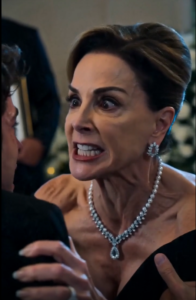
The son, fueled by a mixture of grief and a sudden, primal instinct that something was horribly wrong, didn’t heed Maria’s frantic screech. With a surge of adrenaline, he shoved her aside, her designer heels skidding across the marble floor. The sound of her frantic protest was drowned out by the metallic click-clack of his fingernails against the brass latches of the casket.
“Stop!” Maria shrieked, lunging forward, but it was too late. The latches flew open with a hollow, echoing thwack that seemed to ring through the hall like a gunshot.
The lid creaked upward.
The scent of stale air and terror rushed out. The room fell into such a profound, icy silence that the guests could hear the sharp, ragged hitch of a breath coming from inside. As the lid fell back, the son stumbled, his face turning an ash-gray as he looked down. There, amidst the silk lining and the flowers, lay his father. His eyes were wide, bloodshot, and fixed—not on the ceiling, but directly at his son.
The black tape across his mouth muffled a sound that was less of a human voice and more of a broken, guttural plea.
“Dad?” The son’s voice was a whisper, trembling, as if he were afraid the sight would vanish if he spoke too loudly. He reached out, his hands shaking, and ripped the tape away. The father let out a choked, desperate rasp of air, a sound so raw it made the congregation recoil.
“She…” the father gasped, his voice raspy and thin, his finger trembling as he pointed a shaking hand toward Maria. “She… didn’t… stop.”
Maria stood frozen, the “grieving widow” persona melting away to reveal something far darker—a woman trapped by her own greed. She looked around the room, meeting the eyes of the guests who had been weeping for her just minutes ago. Now, their eyes were full of a sharp, judging light.
Suddenly, the front doors of the funeral hall groaned and were kicked open. It wasn’t the police; it was a team of paramedics followed by two men in suits—private investigators—who had been watching the house for weeks. The lead investigator didn’t look at the coffin; he looked directly at Maria.
“Maria Vance,” he said, his voice cold and emotionless, “you are under arrest for attempted murder and conspiracy to commit fraud.”
Maria didn’t fight. She didn’t scream. She simply slumped, the weight of her failed plan crushing her in an instant. As the officers moved in, the guests scattered, phones out, capturing the scene. The “funeral” had transformed into a crime scene, the “body” was now a witness, and the “widow” was becoming a convict.
The son scrambled to help his father out of the casket, holding him as the paramedics rushed in with a gurney. As they lifted him, the father caught his son’s eye. The terror was fading, replaced by a cold, hard clarity.
“I knew, Son,” the father whispered, clutching his son’s sleeve. “I knew she was planning something. I just didn’t think she was this patient.”
As the ambulance sirens began to wail outside, the father was wheeled past Maria, who was being led out in handcuffs. He didn’t say a word to her. He didn’t have to. The look on his face—the look of a man who had stared into the void and crawled back out—said everything.
The funeral hall began to empty, leaving the white roses strewn about the floor like discarded memories. The candles sputtered and died, leaving the room in shadows. But as the last investigator walked out, he paused by the open casket and picked up a small, gold-plated key that had fallen out of Maria’s clutch. He looked at it, then at the empty room, and a small, knowing smirk crossed his face.
The “dangerous disease” Maria had claimed was a lie, yes. But the vault she had been trying to access with that key? That was very real. And as the heavy oak doors shut, a single question echoed in the empty hall: If she was willing to kill for the inheritance, what exactly was locked in the safe that was worth more than a human life?
