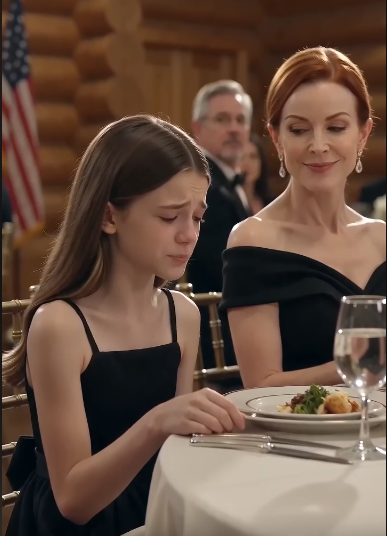
Chapter 1: The Brunch of Betrayal
The house was a sanctuary of curated aesthetics. Every vase of lilies was precisely angled, every coaster aligned with the edge of the mahogany tables, and the air was perpetually scented with vanilla and cedar. To any outsider looking into our life in the quiet, tree-lined suburbs of Chicago, Richard and I were the definition of a “power couple.” He was the visionary executive with the golden smile; I was the supportive, devoted wife; and Sarah, my fourteen-year-old daughter, was the perfect addition to our harmonious unit.
But as the morning sun flooded the kitchen, casting long, sharp shadows across the floor, I didn’t feel the warmth of our life. I felt the cold, creeping dread that Sarah had injected into my veins with a single, crumpled piece of paper.
“Pretend you’re sick and leave.”
I smoothed the note against the cool granite of the kitchen island, my fingers trembling. The words seemed to vibrate with a warning I couldn’t yet comprehend. Outside the kitchen window, the manicured lawn sparkled with dew, and in the distance, I could hear the faint, melodic chiming of the garden gate. The first of the business partners, Mr. Henderson, was arriving for the brunch Richard had spent the entire week obsessing over.
Richard walked in then, his presence filling the room with the scent of expensive cologne and controlled ambition. He was adjusting his cufflinks, his silhouette sharp against the light.
“You’re lingering, Helen,” he noted, his voice smooth as velvet, though the underlying current of command was unmistakable. “The ice sculpture won’t stay perfect forever, and the salmon needs to be plated. We are here to finalize the expansion, not to daydream.”
“I’m just… catching my breath,” I lied, my voice sounding hollow to my own ears.
Sarah was still hovering near the doorway, her shoulders hunched, her eyes darting between me and Richard. She looked like a bird trapped in a room with a predator. I realized then that I had been blind. For two years, I had attributed her distance to the typical, moody friction of a teenager adjusting to a stepfather. I had been wrong. She hadn’t been moody; she had been terrified.
“Well, catch it faster,” Richard said, walking over to press a kiss to my cheek. The contact felt like a shock of static electricity—revolting. He reached for the coffee pot, his movements fluid and practiced. “Everything must be flawless today. My reputation depends on it.”
I watched him move, noting the way he orchestrated the room, the way he projected an image of absolute control. I looked back at Sarah. She was signaling me with her eyes—pleading, desperate.
I made the excuse. The migraine. The sudden, dizzying wave of illness. It was the only card I had to play, and when the words left my lips, Richard’s mask flickered—a fraction of a second where his charm dropped away to reveal a deep, annoyed impatience. But he couldn’t afford to be the ungracious host in front of his partners. He let me go.
We fled that house like thieves in the night. The moment the car tires crunched over the gravel driveway and onto the pavement, I felt a strange, jarring disconnect from the reality I had known for two years.
“Sarah,” I said, my voice barely a whisper as I merged into traffic. “Talk to me.”
She was sobbing silently now, her chest heaving. “He’s going to kill you, Mom. I heard him. He’s planning to do it today. The tea. It’s always the tea.”
The world slowed down, stretching into a surreal, nightmarish landscape. The truck in front of me seemed to distort. Poison. Insurance money. Bankruptcy. The words Sarah spilled out in the car didn’t sound like they belonged to my life; they belonged in a movie, in a thriller, anywhere but my suburban kitchen. And yet, looking at the photographic evidence on her phone—the bank statements, the debt warnings—I knew the nightmare was mine.
Richard wasn’t just a husband. He was a monster who had been starving us of everything while preparing to liquidate our lives for a million-dollar payout.
