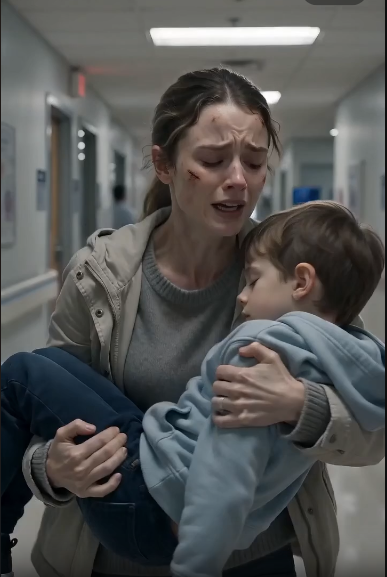
THE DOCTOR RECOGNISED THE MARKS ON THE DYING BOY—BECAUSE HE HAD HELPED PUT THEM THERE
By the time Claire Bennett stumbled through the hospital doors with her unconscious son in her arms, she had already screamed his name so many times that her voice had begun to disappear. Seven-year-old Ethan hung limply against her shoulder, his face white beneath the harsh lobby lights, his breath so faint she could barely feel it against her neck. Nurses rushed forward, but Claire clung to him with the terrified strength of a mother who believed that surrendering her child to anyone—even a doctor—might be the same as losing him.
“Please,” she sobbed. “He collapsed at home. He won’t wake up. Please save him.”
Dr Jonathan Hale hurried from behind the emergency desk, calm and commanding in his white coat. He had spent twenty-five years facing blood, grief and death without allowing fear to reach his face. Yet as he reached for Ethan, the boy’s sleeve slid back from his wrist.
Jonathan froze.
Across Ethan’s forearm were nine thin scratches arranged in perfect symmetry. They curved around one another like a coded diagram, ending in a small circular mark near the pulse. They were too precise to have been caused by a fall, an animal or a frightened child’s fingernails.
The colour drained from Jonathan’s face.
Claire stared at him. “What is it?”
He did not answer.
“Doctor, why aren’t you helping him?”
Jonathan swallowed hard and stepped closer. “Let me see his hand.”
Something in his voice frightened her more than the silence. Claire slowly pulled the sleeve farther down. The complete pattern appeared, and the clipboard slipped from Jonathan’s fingers. It struck the floor with a crack that silenced the nearest nurses.
Jonathan had seen those marks before.
Seventeen years earlier, he had been a young physician at St Gabriel’s Institute, a private research clinic hidden behind the respectable name of a children’s neurological centre. Its director, Professor Adrian Vale, claimed he was developing treatments for infants born with rare brain disorders. Jonathan had believed him until he discovered that Vale was testing an experimental neural compound on healthy newborns whose mothers had been told their babies had died.
Each infant had been marked with a coded pattern so staff could track the results.
Jonathan had tried to expose the programme. Before he could gather enough evidence, the clinic burned down. Records vanished, three researchers disappeared and Vale was declared dead. Jonathan had spent years convincing himself that the surviving children had been rescued and placed in safe homes.
But the mark on Ethan’s wrist belonged to Subject Nine—the only infant whose body had completely adapted to the compound.
“Get him into Resuscitation Three,” Jonathan ordered. “No electronic records. No calls outside this department.”
Claire caught his arm. “You know what those marks mean.”
“I know they mean your son is in danger.”
“He’s my adopted son,” she said. “He was left outside my house when he was six months old.”
Jonathan turned slowly. “Where did you give birth seven years ago?”
Claire’s face tightened. “St Gabriel’s Maternity Centre. They told me my baby died.”
Jonathan closed his eyes.
The name had changed, but the building had once belonged to the institute.
Before he could speak, Ethan’s body convulsed. The heart monitor shrieked, and the medical team rushed him through the emergency doors. Claire followed until a nurse stopped her. Through the glass, she saw Jonathan inject something into Ethan’s IV. The boy’s heart rhythm steadied, but a faint blue light seemed to flicker beneath the marked skin of his arm.
Jonathan emerged several minutes later.
“Ethan is alive,” he said. “But someone activated the compound inside his body.”
Claire stared at him. “Activated it how?”
“With a specific frequency. It can be transmitted through an ordinary device.”
Claire suddenly remembered the small silver music box delivered to Ethan that morning. There had been no sender’s name. When he opened it, a strange melody played. Minutes later, he collapsed.
Police searched her house and brought the box to the hospital. Inside it, investigators found a hidden transmitter and a single fingerprint belonging to Dr Samuel Reed, the hospital’s chief administrator.
Jonathan’s expression changed when he heard the name. Samuel Reed had been Adrian Vale’s closest assistant at St Gabriel’s. He had testified that Vale died in the fire.
Security officers rushed towards Reed’s office, but it was empty. On his desk was a live video feed from Ethan’s room and a folder containing Claire’s medical history. Reed had been watching her for years.
Then the hospital lights went out.
Emergency lamps flooded the corridors in red. Doors locked automatically. Over the intercom came Reed’s calm voice.
“Bring Subject Nine to the underground laboratory, Jonathan. Or the next signal will stop his heart permanently.”
Claire grabbed Jonathan’s coat. “There’s a laboratory beneath this hospital?”
Jonathan looked ashamed. “The hospital was built over the remains of St Gabriel’s.”
They moved Ethan through a service corridor while police searched for Reed. Claire refused to leave her son. In the underground level, they found a laboratory filled with preserved files, experimental drugs and photographs of infants bearing the same marks.
Reed stood beside a transmitter, holding a pistol.
“You destroyed everything,” he said to Jonathan. “Vale’s work could have changed humanity.”
“You murdered babies,” Jonathan replied.
“No. We created survivors.”
Claire noticed a second man behind the glass wall—older, scarred and seated in a wheelchair. Jonathan recognised him immediately.
Professor Adrian Vale had never died.
Vale smiled at Claire. “Your son is the proof that my work succeeded. And you, Mrs Bennett, were chosen because your genetic profile made him possible.”
The final secret was worse than Claire had imagined. Ethan was not merely her stolen biological child. Vale had altered him before birth using an experimental compound, then faked his death and placed him back near Claire so researchers could study him in a natural home. Reed had activated the music box because Ethan’s seventh birthday marked the final stage of the experiment.
As Reed raised the transmitter, Claire threw herself over Ethan. Jonathan lunged for the gun. A shot rang out, striking Jonathan in the shoulder. At the same moment, Claire seized the music box from the trolley and smashed it against the transmitter. Sparks burst across the controls.
Ethan’s monitor stabilised.
Police stormed the laboratory. Reed was arrested, and Vale’s hidden files exposed the names of every stolen child, every bribed official and every falsified death certificate. Vale died in custody months later after refusing treatment for his failing heart. Reed received a life sentence. The hospital board was dissolved, and several families were reunited with children they had believed dead.
Jonathan survived. He publicly confessed his early involvement and surrendered his medical licence, though Claire testified that he had also risked his life to save Ethan and expose the truth. Instead of prison, he spent the following years helping investigators locate the remaining victims.
Ethan recovered slowly. The compound had changed his nervous system, but without the transmitter’s signal, it no longer threatened his life. One spring afternoon, he sat beneath a tree beside Claire and asked why she cried whenever she looked at him.
She pulled him close.
“Because I lost you once,” she whispered. “And somehow, you found your way back to me.”
Ethan rested his head against her shoulder, no longer unconscious, no longer a numbered subject, and no longer someone else’s experiment.
He was simply her son
