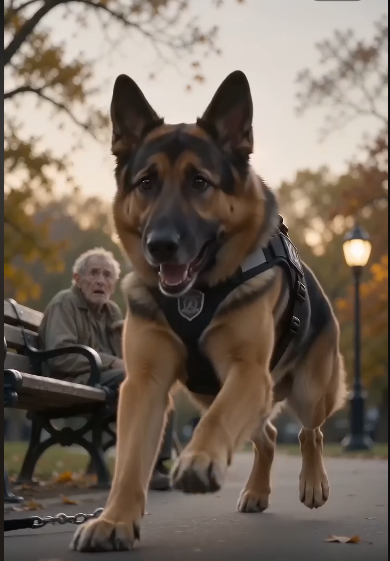
THE POLICE DOG CHARGED AT A LONELY OLD MAN—THEN EXPOSED THE SECRET THAT HAD DESTROYED HIS LIFE
The German Shepherd lunged so suddenly that Officer Daniel Harris nearly lost his grip on the leash.
The chain snapped tight across his gloved hand as the dog dragged him towards an old man sitting alone on a weathered park bench. People nearby stopped walking. A woman screamed. The old man raised his wooden cane with both hands, his face tightening in fear as the animal’s barking echoed through the autumn trees.
“Back!” Daniel shouted. “Hold it!”
But the dog did not stop.
It surged forward, powerful shoulders low, teeth visible, eyes fixed on the stranger. Daniel expected blood. So did everyone watching.
Then, inches from the old man, the barking vanished.
The dog lowered its head and pressed its muzzle into the man’s trembling palm.
Silence settled over the park.
The old man stared down at the black-and-brown coat, then at the police harness across the animal’s back. His cane slipped against the bench. The dog rested its chin on the worn wood and released a soft, broken whimper.
The old man’s lips began to shake.
“Good boy,” he whispered.
The dog closed its eyes.
The old man pulled its head against his chest and began to cry.
“You found me,” he said.
Daniel loosened the leash slowly. “Sir, do you know this dog?”
The man looked up. His name was Arthur Hale, seventy-six years old, a retired police dog trainer who had disappeared from public life nearly eight years earlier. Daniel recognised the name only because it still appeared on an old brass plate inside the K-9 unit.
Arthur looked at the dog’s left ear, where a small triangular scar cut through the fur.
“His name was Ranger,” he said. “I raised him from a pup.”
Daniel shook his head. “This dog is called Rex. He joined our unit six years ago.”
Arthur’s eyes sharpened. “No. Someone changed his name.”
At the station, Rex’s records showed that he had been transferred from a private security kennel after his previous handler died. The original paperwork was incomplete. His early medical files were missing, and the identification number on his microchip had been manually altered.
Daniel’s curiosity became suspicion.
He brought Arthur to the K-9 facility, where Rex ignored every command from the officers until Arthur raised two fingers and spoke quietly.
“Home.”
The dog immediately crossed the room, sat beside him and placed one paw on his shoe.
No one spoke.
Arthur explained that Ranger had once belonged to his son, Michael Hale, a police detective investigating a network that used private security companies to move stolen weapons and launder money. Arthur had trained Ranger to detect explosives and hidden electronics. Michael trusted the dog more than any colleague.
Eight years earlier, Michael died when his car left a rural road and struck a tree. Police ruled that he had fallen asleep at the wheel. Ranger vanished the same night.
Arthur never believed the accident.
“My son called me before he died,” he told Daniel. “He said he had proof against someone inside the department. Then the line went dead.”
Three days later, Arthur’s house was searched without a warrant. Michael’s files disappeared, and Arthur was accused of stealing police equipment. The charge was eventually dropped, but his reputation was destroyed. Friends avoided him. His pension was frozen for months. Grief and shame drove him into isolation.
“Ranger was the last witness,” Arthur said. “And they took him too.”
Daniel reopened the old case quietly. Rex reacted violently whenever he saw the photograph of one particular retired officer: Captain Walter Briggs, the man who had supervised Michael’s investigation and later signed the report declaring his death accidental.
The dog did not bark at the photograph.
It growled.
Daniel searched archived kennel footage and found a damaged recording from the night Michael died. It showed Briggs arriving with Ranger before dawn. He handed the dog to a private security contractor and ordered the staff to change its identification records.
The contractor was owned by Briggs’s brother.
The motive became clear when Daniel traced old financial transfers. Michael had discovered that Briggs was selling seized weapons back to criminal groups through the security company. When Michael collected evidence, Briggs arranged for his car to be forced off the road.
But the proof itself was still missing.
Arthur remembered that Michael had trained Ranger to retrieve small objects on a command only the family knew. Daniel took Rex to the abandoned Hale property where Michael had once lived. The dog searched room after room, then scratched at the floor beneath an old fireplace.
Under a loose stone, police found a sealed metal tube.
Inside was a memory drive containing bank records, photographs, audio recordings and a video made by Michael hours before his death. In it, he named Briggs and described the weapons network. He also said that if anything happened to him, Ranger had been trained to lead Arthur to the evidence.
Briggs had taken the dog before it could complete that final command.
He had not killed Rex because the animal was valuable. Instead, he erased its history, sold it into private service and assumed the dog would eventually forget.
Rex had not forgotten.
Police arrested Briggs at his country home. His brother and three former officers were detained soon afterwards. Faced with the recovered files, one of them confessed that Briggs had ordered Michael’s car struck and later planted stolen equipment in Arthur’s home to discredit him.
Briggs was charged with murder, conspiracy, weapons trafficking, evidence tampering and abuse of office. His rank, medals and reputation disappeared almost overnight.
Arthur’s name was formally cleared.
At the trial, he sat in the front row with Rex lying at his feet. Briggs refused to look at them.
When the guilty verdict was announced, Arthur did not smile. He simply placed one hand on the dog’s head and whispered, “We brought him home.”
Daniel expected Arthur to reclaim Rex permanently, but the old man surprised him.
“He has a duty now,” Arthur said. “And people who love him.”
The police department retired Rex from dangerous operations and appointed him as a therapy dog for injured officers and grieving families. Arthur was invited to help train younger K-9 teams and became a familiar figure at the station again.
He moved out of the small rented room where he had spent years alone and into a cottage near the training grounds. Rex stayed with him every evening and returned to the unit each morning with Daniel.
Months later, they returned to the same park bench.
The trees were green again. Arthur sat with his cane beside him while Rex rested his head on his knee. Daniel stood nearby, watching the old man’s tired face soften.
“For years, I thought everyone had forgotten Michael,” Arthur said.
Daniel looked at the dog.
“Not everyone.”
Arthur stroked the scar on Rex’s ear.
The animal that had once appeared to be attacking him had actually been racing back to the only home it still remembered.
And in finding Arthur, Rex did more than solve a murder.
He returned a father’s stolen honour, restored a son’s truth and proved that loyalty can survive even when names, records and years are taken away.
