THE OFFICER PLANTED DRUGS IN HIS COAT—BUT THE MAN HE FRAMED HAD SPENT THREE YEARS HUNTING THE PEOPLE BEHIND THE BADGE
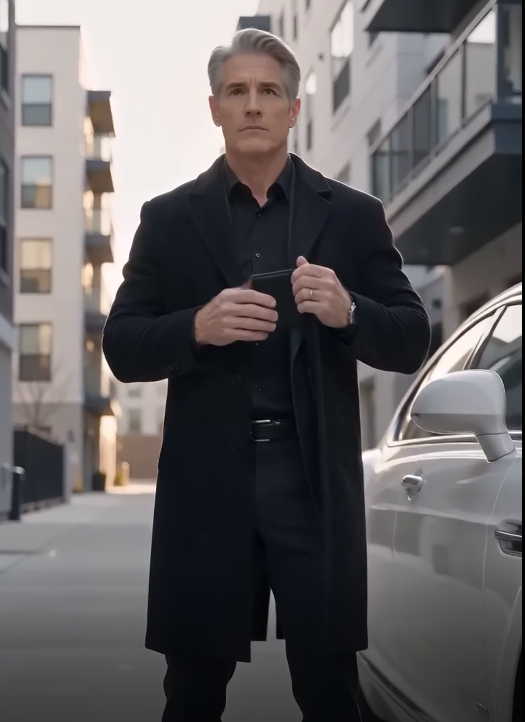
Officer Mason Reed slammed Adrian Cross against the white sedan hard enough to rattle the window. The plastic bag was already hidden between his fingers. With one practised movement, Mason pushed it into the inside pocket of Adrian’s black overcoat, waited half a second, then pulled it out as if he had discovered treasure.
“Well, look what we have here,” he said.
Adrian turned his head slowly. Silver hair, calm eyes, no panic. “You put it there.”
Mason smiled and reached for his handcuffs. “That is what they all say.”
He never managed to open them. Adrian caught his wrist, turned beneath his arm and sent him crashing onto the pavement. The bag landed beside Mason’s hand. Before he could rise, Adrian opened a black leather wallet and showed him a gold federal badge.
“Federal agent,” he said. “And you have just planted evidence on camera.”
Two black SUVs appeared at the end of the alley. Mason’s confidence vanished. He looked towards the roofs, the windows and the rear entrance of the apartment building, suddenly understanding that every escape route had already been closed.
But Adrian had not come merely to catch one corrupt officer.
For three years, the Federal Public Integrity Unit had investigated an impossible pattern. Poor defendants across the city were pleading guilty to drug charges after officers claimed to find identical bags of narcotics in their pockets, cars or homes. Most could not afford proper lawyers. Many accepted deals to avoid longer sentences. The arrest reports appeared convincing, the body-camera footage was often “damaged”, and laboratory records confirmed that the substances were real.
The same names kept appearing: Officer Mason Reed, Sergeant Cole Barrett and Captain Warren Rourke.
Yet every witness who tried to speak changed their story or disappeared.
The case became personal for Adrian when his younger brother, Daniel, was arrested during a traffic stop. Mason claimed to have found drugs beneath Daniel’s passenger seat. Daniel insisted they had been planted, but nobody believed him. He lost his teaching job and spent eighteen months in prison. Two weeks after his release, he died from an overdose in a shelter.
Adrian had found a letter among his belongings.
I stopped fighting because even the truth sounded guilty when they told it in a uniform.
Since then, Adrian had carried those words everywhere.
The operation in the alley was designed to force Mason into repeating his method against a target he believed was wealthy, isolated and frightened enough to pay for silence. Adrian’s sedan contained three hidden cameras. His coat had another device sewn into its lining. Every movement had been transmitted live to federal investigators.
Mason was taken to an unmarked interview room. At first, he denied everything.
“You assaulted an officer,” he said through clenched teeth. “That badge does not erase that.”
Adrian placed a tablet on the table and played the footage. Mason watched his own fingers slip the bag into the coat.
His face changed, but he still said nothing.
Then Adrian showed him photographs of twelve people convicted after Mason’s arrests. One was a young mother who had lost custody of her daughter. Another was a university student deported after serving six months. The final photograph was Daniel.
Mason looked away.
“You arrested my brother,” Adrian said. “Did you plant the drugs in his car?”
“I followed orders.”
The answer was so quiet that Adrian nearly missed it.
Mason admitted that Captain Rourke had created the scheme. The officers targeted vulnerable people and planted drugs during searches. Prosecutors praised the unit’s extraordinary conviction rate, while Rourke received promotions and political support. But arrests were only one part of the operation.
The drugs came from police evidence rooms.
Rourke and Barrett removed seized narcotics, divided them into small packets and used them to manufacture new cases. They then sold the remaining supply through criminal intermediaries. Anyone who resisted was threatened with additional charges. Anyone who complained was labelled violent or unstable.
Daniel had been selected because he accidentally photographed Mason meeting a dealer behind a nightclub. When Mason noticed him, he stopped Daniel’s car and planted evidence to destroy his credibility.
“He kept saying he had a photograph,” Mason confessed. “Rourke told me to make sure no one believed him.”
Adrian’s hands tightened beneath the table. “Did you know what happened after prison?”
Mason nodded. “I heard.”
For a moment, the federal agent looked less like an investigator and more like a grieving brother. Yet he did not strike Mason or raise his voice.
“You will testify against Rourke,” he said. “And you will name every person whose life you helped destroy.”
Mason agreed, not from courage but from fear of spending the rest of his life in prison.
Federal teams raided the central police station before dawn. Sergeant Barrett was caught attempting to burn documents in a maintenance room. In Captain Rourke’s home, agents found cash, confiscated drugs and a private ledger listing payments from dealers. They also recovered Daniel’s missing phone from a locked desk drawer.
The photograph was still on it.
It showed Rourke himself exchanging an evidence box for a suitcase of money.
When Rourke was brought into court, he maintained the same cold authority he had worn for twenty-seven years.
“You are damaging public trust,” he told Adrian.
“No,” Adrian replied. “You did that every time you used a badge to make a lie look lawful.”
The trial lasted nine weeks. Mason testified to every false arrest, every planted packet and every threat. More than sixty convictions were reopened. Twenty-eight people were cleared immediately, while others received new hearings. Families were reunited, immigration orders were reversed and compensation funds were established for those wrongfully imprisoned.
Rourke was convicted of conspiracy, drug trafficking, evidence tampering and obstruction of justice. Barrett received a long sentence. Mason’s cooperation reduced his punishment, but he still went to prison and was permanently banned from law enforcement.
Daniel’s conviction was overturned posthumously.
At the hearing, the judge read his name into the record and declared that the evidence against him had been fabricated. Adrian sat alone in the front row, holding his brother’s letter. He had imagined the moment for years, but when it arrived, justice felt quieter than revenge.
Afterwards, the young mother from Mason’s photograph approached him with her daughter. The child held out a drawing of three figures standing beneath a bright sun.
“My mum said you helped bring her home,” she said.
Adrian accepted it with trembling hands.
Months later, he created the Daniel Cross Legal Defence Fund to provide representation for people accused by officers with histories of misconduct. The first office opened in the neighbourhood where Daniel had taught. His old classroom photograph hung near the entrance, not as a picture of a convicted man, but of a teacher smiling beside his students.
Adrian never stopped grieving. Healing did not erase the prison letters, the ruined career or the brother he could no longer save. It simply gave the pain somewhere useful to go.
The corrupt officers had believed a badge could make any story true.
In the end, it was another badge—and one brother’s refusal to remain silent—that made the truth impossible to bury.
