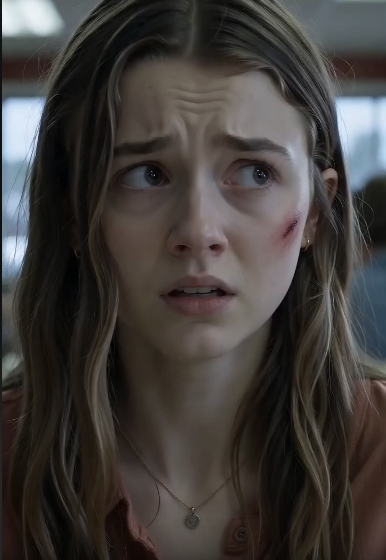
SHE LEFT TWO WORDS ON A NAPKIN—AND THE STRANGER WHO READ THEM UNCOVERED THE MURDER HER CAPTOR HAD BURIED
Emma Reed tapped the table three times, paused, then tapped three longer beats.
Nobody in the roadside diner seemed to notice. Plates clattered, coffee poured and a tired child argued over a slice of pie. Only the bearded man at the next table lifted his eyes.
Mason Briggs had spent twelve years as an army medic. He knew Morse code.
S. O. S.
Across from Emma, Frank Miller tightened his hand around her wrist.
“Get up,” he said. “We’re leaving.”
Emma rose without arguing. A red bruise darkened her cheek, and fear sat so visibly in her eyes that Mason felt his stomach tighten. Frank pulled her towards the exit, keeping his body between her and the other customers.
As Emma passed Mason’s table, a crumpled napkin slipped from her fingers.
Frank did not see it fall.
Mason waited until the door closed, then bent down and unfolded the paper.
Two words had been written in eyeliner.
HELP ME.
He looked through the window. Frank was forcing Emma into a grey pickup truck.
Mason called emergency services before he moved.
He gave the dispatcher the vehicle registration, its direction and a description of both people. Then he followed on his motorcycle, keeping far enough behind not to be noticed.
The waitress, Nora Bell, brought the diner’s security footage to the police. It showed Frank gripping Emma beneath the table and whispering into her ear whenever she glanced towards another customer.
It also showed something no one had noticed at the time.
Emma had no shoes.
Frank drove for nearly twenty miles before turning onto a narrow road leading through woodland. Mason slowed and watched the pickup disappear beyond an old iron gate marked REED FARM.
The name changed everything.
Six weeks earlier, local news had reported that twenty-year-old Emma Reed had disappeared after the death of her mother, Leah. Police believed she had run away while grieving. Her stepfather, Frank Miller, had appeared on television asking her to come home.
Mason had seen that interview.
Frank had cried for the cameras.
Now he was dragging the missing girl back to her family’s abandoned farmhouse.
Mason stopped beside the road and updated the dispatcher. Officers were coming, but the nearest patrol car was fifteen minutes away.
From inside the farmhouse came the sound of breaking glass.
Then Emma screamed.
Mason crossed the gate.
He found the kitchen door unlocked. Inside, Frank had pushed Emma against a table. Legal documents lay beside a handgun and a small voice recorder.
“You sign tonight,” Frank said, “or you die the same way she did.”
Mason held his phone low, keeping the emergency operator connected.
Emma saw him in the doorway but did not react. She understood immediately that surprise was the only advantage they had.
Frank shoved a pen into her hand.
The papers transferred Reed Farm, two rental properties and the remaining balance of Leah Reed’s life-insurance policy into an account controlled by Frank.
Emma’s hand trembled.
“You killed her for this,” she said.
Frank’s face hardened. “Your mother should have stopped asking questions.”
The confession travelled through Mason’s open phone line.
Emma had already suspected the truth. Three days before Leah’s death, she had discovered that Frank had secretly borrowed against the farm and forged Leah’s signature on several loans. Leah planned to report him.
That night, she fell from the farmhouse staircase.
Frank claimed it was an accident.
Emma found her mother’s broken necklace beneath the banister and blood on the cuff of Frank’s jacket. Before she could reach the police, Frank took her phone, locked her in a hunting cabin and began moving her between isolated properties.
For six weeks, he forced her to record messages saying she had left voluntarily.
The diner stop had been a mistake. Frank needed cash and food before crossing the state border. He believed Emma was too frightened to seek help in public.
He had not realised she knew Morse code from her grandfather.
Mason stepped into the kitchen.
“Let her go.”
Frank spun and reached for the gun.
Emma swept the documents from the table. The handgun fell with them and slid across the floor. Mason drove his shoulder into Frank before he could retrieve it.
They crashed into a cupboard. Frank struck Mason twice, then reached for a kitchen knife. Emma kicked the knife beneath the refrigerator and ran towards the door.
Frank caught her hair.
Mason pulled him away just as police sirens rose beyond the trees.
Frank froze.
For the first time, fear replaced control on his face.
Officers entered with weapons drawn. Frank was forced to the floor and handcuffed. In his jacket they found Emma’s missing identification, Leah’s jewellery and a key to the hunting cabin where Emma had been held.
The farmhouse contained the rest of the truth.
Police recovered forged loan papers, sedatives, ropes and videos Frank had forced Emma to record. The voice recorder on the kitchen table held an older argument between Frank and Leah.
“You stole from me,” Leah said in the recording.
Frank replied, “Everything you own will be mine when you’re gone.”
Investigators reopened Leah’s death. Forensic examination found that the injuries on her arms were consistent with being restrained before the fall. Frank’s fingerprints were discovered beneath a section of wallpaper where he had hidden her torn sleeve.
His solicitor, Calvin Price, had prepared the fraudulent transfer documents and helped disguise the stolen loans. He was arrested two days later.
Frank was convicted of murder, kidnapping, unlawful imprisonment, fraud and attempted coercion. He received life imprisonment without the possibility of parole. Price was sentenced for conspiracy and financial crimes.
Emma testified without looking at Frank.
When the prosecutor asked how she had survived, she answered, “I kept looking for one person who might notice.”
Healing did not come as quickly as justice.
For months, Emma could not sit with her back to a door. The sound of a pickup truck made her hands shake. She slept with the light on and kept shoes beside her bed because Frank had always taken them to prevent her from running.
Mason never called himself a hero. He visited once at the rehabilitation centre, placed the folded napkin on the table and said, “You saved yourself. I just read the message.”
A year later, Emma reopened the roadside diner’s unused back room as a small crisis centre for people escaping captivity and domestic abuse. Nora volunteered there. Mason installed the locks and refused payment.
Above the entrance, Emma placed a simple sign:
WE NOTICE.
Frank had hidden her in plain sight because he believed strangers would look away.
One stranger did not.
And the two words Emma dropped onto a diner floor became the beginning of the life he had tried to erase.
