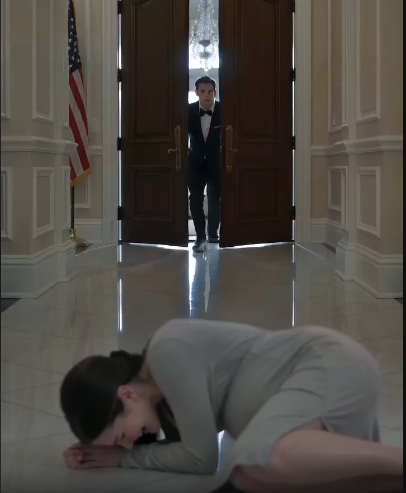
Chapter 1: The Truth Unleashed
The silence shattered when the hospital director stormed into the room.
“Clear the floor. Now.”
His voice carried authority that no one dared question. Nurses rushed in. Security followed. Within seconds, Isabella’s performance began to crack under the weight of real power.
“Uncle…” Khloe whispered weakly.
The director froze for a fraction of a second—then his expression hardened into something far more dangerous than anger.
“Get her to the operating room. Immediately.”
Marcus snapped out of his shock and dropped to his knees beside Khloe.
“Stay with me… please,” he said, his voice breaking for the first time.
As they wheeled her out, Isabella took a step back.
“I—I didn’t—she attacked me—”
“Enough.”
Security seized her arms.
“You’ll explain everything,” the director said coldly, “after we review the footage.”
And that was the moment Isabella realized—
she had already lost.
Chapter 2: What the Cameras Saw
The security footage review room was small and cold in the specific way of rooms that exist for accountability rather than comfort — bare walls, a single long monitor mounted at eye level, two chairs that had clearly been designed without anyone’s physical comfort in mind.
The hospital director, whose name was Dr. Victor Sheen and who had spent thirty-one years building this institution from a mid-sized regional clinic into the most respected private medical facility in the city, sat in one of those chairs with the controlled stillness of a man who had learned, across three decades of medical administration, that the moments requiring the most decisive action were best approached without visible emotion.
He had not yet allowed himself to feel what he’d seen in that room upstairs.
His niece on the floor. The IV line pulled loose. The way she’d looked at him when he walked in — not the look of someone who had fallen, not the look of an accident, but the specific, exhausted look of someone who has been waiting for help for a long time and is not entirely sure it has actually arrived or if they are imagining it.
He had seen that look once before, on a patient twenty years ago, and he had never forgotten what it meant, and he had acted on it then and he was acting on it now, and the emotion — the uncle part of him, the man who had held Khloe at her christening and taught her to play chess on Sunday afternoons and watched her grow into a woman of specific, remarkable quality — that part would have its moment later, in private, where it belonged.
Right now he needed to watch the footage.
The security supervisor, a careful man named Ray who had been with the hospital twelve years and understood instinctively the weight of what was being asked of him tonight, queued the recording from Room 4-North without speaking.
The timestamp read fourteen hours earlier.
Dr. Sheen watched.
Isabella Crane had arrived in Khloe’s room at eleven-seventeen in the morning, while the nursing shift was in the middle of its transition — the brief, predictable gap when attention was distributed across the floor rather than concentrated at any single point, a gap that anyone who had spent enough time in a hospital would know about, and Isabella had spent a great deal of time in this hospital over the past three months, always visiting, always charming, always the devoted friend who brought flowers and adjusted pillows and asked nurses about medication schedules with the specific, solicitous attention of someone who wanted to know.
She had closed the door behind her at eleven-nineteen.
The camera inside the room — a requirement of the hospital’s patient safety protocol, installed after a liability case four years earlier, the existence of which Dr. Sheen doubted Isabella knew about — showed everything that happened after.
It was not a violent scene, in the way the word violence usually implies. There was no striking, no physical assault in the dramatic sense. What there was, over the course of forty-three minutes, was something that required a different vocabulary — a systematic, deliberate dismantling, conducted in a low voice and with the controlled patience of someone who had been planning this particular conversation for a long time and had decided that today was the day to finish it.
Dr. Sheen watched Isabella sit beside Khloe’s bed and take out her phone. Watched her show Khloe something on the screen — he couldn’t see what, the angle wasn’t right for the phone’s display. Watched Khloe’s face change as she looked at it. Watched Isabella speak for seven uninterrupted minutes in a voice too quiet for the room’s audio to clearly capture, though fragments came through: Marcus, you should know, I didn’t want to be the one, but someone had to tell you.
Watched Khloe’s vital monitor begin to climb.
Watched Isabella notice it climb and not stop talking.
Watched Khloe’s hand move toward the call button, and watched Isabella’s hand move slightly, casually, in a way that left the call button just out of reach without ever quite touching it.
That last detail made Dr. Sheen close his eyes for exactly three seconds.
Then he opened them and kept watching.
At eleven-fifty-nine, Khloe’s monitor alarmed. At twelve-oh-one, a nurse appeared at the door. At twelve-oh-two, Isabella was standing in the center of the room with a broken IV stand on the floor beside her and the specific, wide-eyed expression of a woman constructing a story in real time, the story about Khloe becoming agitated, about the IV stand falling, about Isabella trying to help.
Dr. Sheen had walked into that room eleven minutes later.
He had seen enough of the footage now.
He turned to Ray.
“Copy everything from eleven-seventeen to twelve-thirteen,” he said. “Full resolution. Chain of custody documentation. I want it preserved and logged within the hour.”
“Yes, sir.”
“And Ray.” Dr. Sheen stood slowly. “Who else has seen this footage tonight?”
“Just us, sir.”
“Keep it that way until my legal team arrives. Nobody in or out of this room without my authorization.”
Ray nodded.
Dr. Sheen walked out of the security office and took the elevator to the surgical floor, where Khloe was being stabilized, where the attending cardiac team was doing what they were trained to do, where the outcome of the next several hours was in hands far more capable than his.
He stood in the corridor outside the surgical suite and allowed himself, finally, exactly ninety seconds of what he’d been containing since he walked through the door of Room 4-North and saw his niece on the floor.
Then he took out his phone.
He had three calls to make.
The first was to the hospital’s legal counsel.
The second was to the city’s chief of police, who had been a close friend for twenty years and who answered on the second ring with the relaxed tone of a man expecting a social call, an expectation that did not survive Dr. Sheen’s first sentence.
The third call was the one he’d been dreading, and he made it last, standing in the window alcove at the end of the surgical corridor with the night city spread out below him, and when Marcus answered from somewhere downstairs, clearly having not left the building, his voice carrying the tight, barely-controlled register of a man running on adrenaline and fear, Dr. Sheen said: “She’s in surgery. She’s stable. And Marcus — I need you to come upstairs. There are things you need to see before morning.”
Part of him — the uncle part, the one he’d kept carefully controlled for the last two hours — wanted to say more. Wanted to tell Marcus what the footage showed, wanted to prepare him for the full weight of what the next conversation was going to require him to absorb.
He didn’t, because some things couldn’t be prepared for.
Chapter 3: Marcus and the Forty-Three Minutes
Marcus had believed, walking into this hospital that morning, that the worst thing that could happen to him had already happened.
He had been wrong.
The worst thing, he now understood, sitting across from Dr. Victor Sheen in a small conference room on the fourth floor with a tablet on the table between them showing forty-three minutes of footage he had just watched twice, was not that Khloe had been in danger. The worst thing was understanding how long she had been in danger before he knew. Understanding the specific geometry of how it had been kept from him.
He watched the footage a third time without speaking, focusing on the detail he’d almost missed the first two viewings — Isabella’s hand, moving with that casual, precise adjustment, leaving the call button three inches further from Khloe’s reach without ever quite touching it.
He stopped the playback at that frame.
“She knew about the monitor,” he said. His voice was very flat.
Dr. Sheen looked at the frozen image. “She’s been in and out of this hospital enough to know that a cardiac event of sufficient severity would trigger an automatic alert to the nursing station. She needed time. The monitor alarmed at the threshold she apparently calculated would give her the outcome she wanted while maintaining plausible deniability.”
“What outcome did she want?”
The doctor was quiet for a moment.
“That’s the question we need to answer carefully,” he said. “The footage shows deliberate psychological distress and clear interference with the patient’s ability to summon help. What we can’t hear clearly enough to document fully is the content of what she was saying for those seven minutes.”
“I know what she was saying,” Marcus said.
Dr. Sheen looked at him.
“She’s been saying it to me for three months,” Marcus said. “In smaller pieces. More deniable pieces. Things about Khloe that were framed as concern — as a friend being honest with me about things she’d observed, things that worried her. About Khloe’s health. Her mental state. Her—” he stopped. Started again. “Isabella has been telling me, for three months, in the patient, careful way of someone who understands that the first time you say something it gets dismissed but the twelfth time it starts to sound like pattern recognition — she’s been telling me that Khloe was not the person I believed her to be.”
He looked at the frozen image on the screen.
“And I was listening,” he said. “That’s what I keep coming back to. I was listening to her.”
Dr. Sheen was quiet.
“There’s something else you need to know,” the doctor said carefully. “Before Khloe went into surgery, she was conscious for about four minutes. She asked the attending nurse for a paper and pen. This is what she wrote.”
He placed a single sheet of paper on the table.
Khloe’s handwriting, which Marcus knew as well as his own, had been shaking — the letters uneven, the pressure inconsistent, the hand of someone fighting hard to be legible when her body was working against her. But it was clear enough. Three sentences, written in sequence, as if she’d been composing them in her mind for a long time and only needed the paper to exist for the writing to be fast.
The documents are in the blue folder in my desk at home, left drawer.
She has been doing this for eleven months, not three.
I tried to tell him. Please make sure he reads them himself.
Marcus read the three sentences four times.
Eleven months.
He thought about eleven months ago. What had been different. What had changed. When Isabella had first appeared in their lives as Khloe’s friend from the foundation board, warm and attentive and always available, always present at exactly the moments that were most significant, always knowing the right thing to say.
He thought about the gradual, comfortable way she’d moved from Khloe’s friend to their mutual friend to someone whose presence in his daily life had become so normalized he’d stopped noticing it was there.
“She played the long game,” he said.
“Yes,” Dr. Sheen said.
“This wasn’t about today.”
“No.”
Marcus stood up and walked to the window. The city below was doing its ordinary nighttime things — traffic, lit windows, the indifferent hum of a place that didn’t know what was happening in this room — and he stood there for a moment with his back to the doctor, doing the specific, difficult work of reorienting himself inside a version of the last eleven months that was entirely different from the one he’d believed he was living.
He turned around.
“Where is she?” he asked. “Isabella.”
“In a holding room downstairs. The police arrived twenty minutes ago. She hasn’t asked for a lawyer yet, which her lawyer, when she eventually calls one, is going to be unhappy about.” Dr. Sheen paused. “Marcus, I need to ask you something directly. The blue folder Khloe mentioned. Whatever is in it — do you want me to send someone to your home tonight, or do you want to go yourself?”
Marcus picked up the sheet of paper with Khloe’s three sentences.
“I’ll go myself,” he said. “She said he should read it himself. She meant me.”
He looked at the handwriting — shaking, effortful, the last clear-headed act of a woman who had understood, going into surgery, that she might not have another chance to be heard and had spent her four conscious minutes making sure the truth had a path to travel.
He had not listened closely enough for eleven months.
