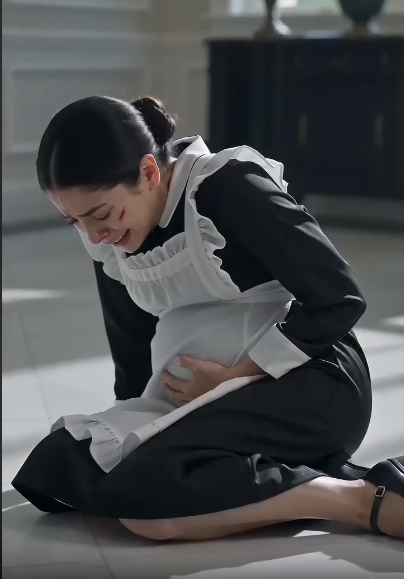
THE PREGNANT MAID WAS FORCED TO HER KNEES—BECAUSE SHE SAW WHO POISONED THE WINE
Rosa Alvarez hit the marble floor hard enough to send pain through her knees and into the child beneath her heart. One hand flew to her stomach. The other remained clenched around the silver teaspoon she had torn from Margaret Hart’s fingers.
“Give it back,” Margaret whispered.
Her voice was quiet, but her face was not. The elegant woman who ruled Hartwood Manor stood above Rosa in a black silk gown, her eyes sharp with panic. Behind her, on the kitchen counter, a crystal wine glass waited on a silver tray. A faint white residue clung to its rim.
Upstairs, Claire Hart was preparing to toast the pregnancy she had announced only an hour earlier.
Rosa looked towards the servants’ staircase. “Mrs Hart must not drink that.”
Margaret grabbed her hair and forced her head back. “You saw nothing.”
“I saw you empty the powder into her glass.”
“You are a maid. An illegal one, if I make a single telephone call. Who do you think my son will believe?”
Rosa’s breath caught. She had worked at Hartwood for three years, cleaning rooms no guest ever saw and listening to secrets wealthy people believed disappeared when doors were closed. She had endured Margaret’s insults because the wages paid for her younger brother’s schooling and the small flat where she planned to raise her baby.
But upstairs, Claire was carrying a child too.
Rosa pushed herself upright. “I would rather lose everything than let you kill her.”
Margaret raised her hand.
Before she could strike, the kitchen door opened.
Alexander Hart stood in the doorway, still wearing the dark overcoat he had taken to London that morning. Rain glistened on his shoulders. His gaze moved from Rosa on the floor to his mother’s raised hand, then to the wine glass on the tray.
“Alexander,” Margaret said quickly. “Thank God. I caught her stealing.”
Rosa’s fear vanished beneath something stronger. She pointed towards the glass.
“Your mother poisoned your wife’s wine.”
The room fell silent.
Margaret laughed, but the sound came too quickly. “She has been taking jewellery from Claire’s dressing room. I confronted her, and now she is inventing this.”
Alexander did not look at Rosa. He looked at the teaspoon in her hand.
“What is on that?”
“I don’t know,” Rosa said. “She poured it from a blue bottle.”
Margaret stepped towards the counter, but Alexander moved first. He lifted the tray and held it beyond her reach.
“Put the glass down,” Margaret snapped.
“No,” he replied. “I’m having it tested.”
For the first time, her composure cracked.
Upstairs, Claire called his name.
She appeared moments later at the kitchen entrance, one hand resting on the gentle curve of her stomach. Her smile disappeared when she saw Rosa kneeling beside the table.
“What happened?”
Margaret turned to her. “This woman tried to rob you.”
“She tried to save you,” Alexander said.
He telephoned the family doctor, then the police. Margaret protested, threatened and finally demanded that everyone leave her house. But Hartwood had belonged to Alexander since his father’s death, and that night, he ordered the gates locked.
The laboratory result arrived before midnight.
The wine contained a concentrated dose of warfarin, a blood-thinning drug that could have caused catastrophic bleeding. For Claire, who had suffered complications in an earlier pregnancy, it might have killed both mother and child.
Margaret was arrested in the drawing room beneath the portrait of her late husband.
Yet even as officers led her away, she stared at Claire and said, “You have no idea what that woman has done to this family.”
The words troubled Alexander. So did the blue bottle, which police found hidden in Margaret’s bathroom cabinet. It carried a prescription label in another name: Dr Edward Bell.
Bell had been the Hart family’s private physician for nearly twenty years. He was also the doctor who had declared Alexander’s father dead after what everyone believed was a stroke.
Detective Inspector Naomi Reed reopened the old medical file.
Within days, the truth began to surface.
Alexander’s father had not suffered a natural stroke. His blood samples, preserved by the private hospital, showed prolonged exposure to the same drug found in Claire’s wine. He had been slowly poisoned over several months.
Financial records revealed the motive. Before his death, Richard Hart had discovered that Margaret and Dr Bell were diverting money from the family charitable trust. More than four million pounds intended for children’s hospitals had been transferred through false companies. Richard planned to report them and remove Margaret from his will.
He died two nights before meeting his solicitor.
Claire had recently found a locked ledger among Richard’s papers. She did not understand the coded payments, but she had told Margaret that she intended to show them to Alexander after the pregnancy toast.
That was why the wine had been poisoned.
Margaret had not acted to protect her son. She had tried to silence the final person who could expose her.
Dr Bell was arrested at Heathrow Airport with a passport, cash and a one-way ticket to Switzerland. Confronted with the medical evidence, he confessed that Margaret had planned both poisonings. He had supplied the drugs, altered Richard’s records and signed the false death certificate. In return, she had promised him half the stolen money.
Margaret denied everything until police recovered a recording from the old nursery monitor.
Rosa had found the device weeks earlier while clearing a cupboard. She had placed it in the kitchen to listen for the housekeeper’s bell while working in the laundry room. On the night of the toast, it captured Margaret speaking to Bell on the telephone.
“Richard should have kept quiet,” she had said. “Claire will make the same mistake.”
At trial, the recording ended all doubt.
Margaret Hart was convicted of murder, attempted murder, fraud and conspiracy. Dr Bell received a lengthy prison sentence and was permanently struck from the medical register. The stolen charitable funds were recovered from overseas accounts and returned to the hospitals they had been meant to serve.
Rosa, however, feared she would still lose her job.
A week after the verdict, Alexander and Claire asked her to join them in the garden. Spring sunlight covered the lawn, and the first roses had begun to open.
Claire placed an envelope in Rosa’s hands.
Inside was permanent residency sponsorship, a deed to a small cottage on the estate and enough money to provide for her child’s education.
Rosa shook her head. “I cannot accept all this.”
“You accepted the risk of losing everything for me,” Claire said. “Let us give something back.”
Months later, Rosa gave birth to a daughter. She named her Hope.
Claire delivered a healthy boy soon afterwards, and the two children grew up crossing the same garden paths, unaware that one mother’s courage had saved them both before they were born.
Hartwood Manor never again felt like Margaret’s house. Its locked rooms were opened, its stolen money restored, and its silence finally broken.
Above the kitchen fireplace, Claire placed the silver teaspoon in a glass frame.
Beneath it were six words:
She had no power, yet she spoke.
