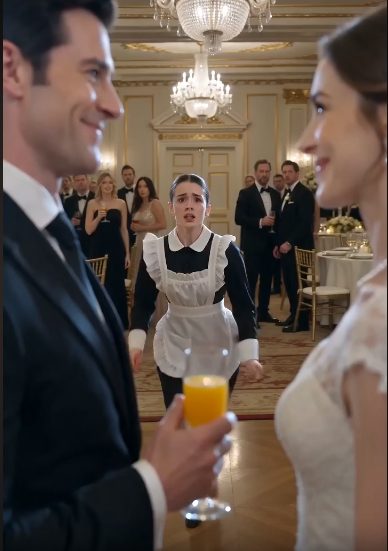
THE BRIDE SLAPPED THE MAID FOR STOPPING THE TOAST—THEN THE VIDEO EXPOSED WHY THE GROOM WAS NEVER MEANT TO LEAVE HIS OWN WEDDING ALIVE
The glass shattered before Daniel Whitmore could raise it to his lips.
Orange juice swept across the white tablecloth, splashed the bride’s dress and dripped from the edge of the banquet table. In the stunned silence that followed, the young maid stood between Daniel and the broken glass, breathing so hard that her shoulders shook.
Cassandra Whitmore struck her across the face.
The slap cracked through the wedding hall more sharply than the glass had. Guests in tuxedos and evening gowns turned towards the aisle. The string quartet stopped mid-note.
“What is wrong with you?” Cassandra demanded.
The maid, Elena Ruiz, pressed one hand to her burning cheek. Tears had already filled her eyes, but she did not step back.
“Don’t drink it,” she whispered. “Something was put in it.”
A murmur moved through the room.
Daniel stared at Elena. He knew her only as one of the temporary staff hired for the reception. She had refilled water glasses, cleared plates and stood silently near the service doors. He had never asked her name.
Cassandra’s expression hardened. “She is lying. Security, remove her.”
Two guards approached, but Elena pulled a phone from her apron.
“I saw her,” she said. “I recorded it because no one would believe me.”
The video showed Cassandra standing alone beside the wedding table twenty minutes earlier. She looked over her shoulder, removed a small silver packet from her clutch and crushed a white tablet into Daniel’s glass.
The entire hall seemed to stop breathing.
Daniel watched the recording twice. On the second viewing, he noticed Cassandra’s hands were steady. There was no panic, no hesitation, no mistake.
He turned towards his bride.
“What did you put in my drink?”
Cassandra’s face had gone pale, but her voice remained controlled. “It was something to calm you. You were anxious.”
“I was not anxious.”
“You barely slept last night.”
“So you drugged me?”
Her father, Charles Vale, rose from the front table. He was chairman of Vale Meridian, the investment company that had merged with Daniel’s family business six months earlier.
“This is an unfortunate misunderstanding,” Charles said. “Cassandra was trying to help her husband.”
Elena shook her head.
“That isn’t all.”
From her apron, she produced a folded pharmacy receipt. The medication was not a mild sedative. It was a powerful substance capable of causing respiratory failure when mixed with alcohol.
A doctor among the guests examined the glass residue and immediately called emergency services.
Daniel looked from Cassandra to Charles. “Why?”
Neither answered.
Then an elderly woman stood near the rear of the hall.
Her name was Margaret Cole, Daniel’s former housekeeper. She had served his family for thirty years before being dismissed shortly after the merger.
“Elena is my granddaughter,” she said. “I sent her here.”
The secret had begun three months earlier, when Margaret found Daniel’s late father’s study unlocked. Inside a hidden drawer were copies of trust documents showing that Daniel would gain full control of Whitmore Technologies only after his marriage. If he died within thirty days of the ceremony, his voting shares would transfer temporarily to his spouse.
Cassandra would become the controlling shareholder.
Her father’s company would then acquire Whitmore Technologies at a fraction of its value.
Margaret had taken photographs of the documents, but before she could warn Daniel, Charles accused her of stealing jewellery and had her removed from the estate. The police found nothing, yet Daniel believed the accusation and allowed the dismissal to stand.
Elena had taken a job at the wedding because Margaret feared the plan would be carried out during the reception.
Daniel felt shame rise beneath his collar.
“I should have listened to you,” he said.
Margaret’s gaze was not cruel. “You trusted people who looked respectable.”
A siren sounded outside.
Cassandra suddenly moved towards the service corridor, but Elena blocked her path. One of the security guards, now understanding the danger, locked the exit.
Charles attempted to leave through the main doors.
Daniel called after him. “Was this your plan?”
Charles stopped.
For years, he had built a reputation as a disciplined financier, but the merger concealed enormous debts. Vale Meridian was weeks from collapse. He needed Whitmore’s patents, factories and government contracts to survive.
Cassandra had agreed to marry Daniel, gain his trust and inherit control after his death. The drug would make him collapse during the toast. Charles’s private physician was prepared to declare it an undiagnosed heart condition, and the remaining powder would be removed before investigators arrived.
The bride had never loved the groom.
The wedding had been designed as an elegant crime scene.
Police officers entered the hall as Cassandra began shouting that her father had forced her.
“He said it was the only way to save our family,” she cried. “He told me Daniel would never feel anything.”
Charles looked at his daughter with disgust. “You wanted the company as much as I did.”
Their accusations broke whatever loyalty remained between them.
Elena handed the police another recording. It captured Cassandra and Charles arguing in the catering corridor that morning.
“If the dose fails,” Charles had said, “give him the second glass.”
Cassandra answered, “And after he is gone?”
“You become the grieving widow. Leave the rest to me.”
Both were arrested before the wedding cake was cut. Charles was later charged with conspiracy, attempted murder, fraud and falsifying financial records. Cassandra pleaded guilty after investigators found the medication in her bridal suite and messages discussing Daniel’s death certificate. The physician who agreed to conceal the cause of death lost his licence and went to prison.
Vale Meridian collapsed, but Whitmore Technologies survived. Daniel cancelled the merger and returned the employees and patents Charles had tried to seize.
He also publicly cleared Margaret’s name.
Justice, however, did not erase Daniel’s humiliation. For months, he woke from dreams in which he lifted the glass and no one stopped him. He stopped attending parties and found it difficult to trust anyone who spoke gently.
Elena never asked for a reward.
When Daniel offered her money, she refused.
“My grandmother taught me that saving someone does not make them owe you their life,” she said.
“What does it make me owe you?”
“The courage to notice people before you need them.”
Daniel did not forget those words.
A year later, he established a protection fund for hotel and domestic workers who reported crimes committed by powerful employers. Margaret became one of its advisers. Elena used a scholarship from the fund to study nursing.
At the first annual dinner, Daniel stood before hundreds of guests in the same hall where his wedding had ended. The chandeliers were unchanged, but the atmosphere was warmer.
He invited Elena to the stage.
She hesitated, then walked towards him wearing a simple blue dress instead of a maid’s uniform.
Daniel raised a glass of orange juice.
The room became still.
He smiled gently and placed it on the table without drinking.
“This time,” he said, “I know who prepared it.”
Elena laughed, and Margaret wiped away a tear.
The woman once treated as invisible had saved his life. But the deeper gift was not that she had stopped one poisoned glass.
She had taught him that dignity should never depend on a uniform, wealth should never be mistaken for goodness, and sometimes the person standing quietly at the edge of the room is the only one brave enough to tell the truth.
